
Mileage alone does not reveal the battery's condition
The used electric vehicle market presents a challenge requiring a more thorough assessment than simply checking the mileage. Battery health—a component that significantly influences a used vehicle's range and value—can vary markedly even between two vehicles of the same model that appear to have seen similar usage.
Recent research conducted by AVILOO has quantified these discrepancies following a meticulous analysis of over 500,000 electric vehicle batteries. The study concludes that the gap between the best and worst units of a single model can reach 13.5 percentage points in State of Health (SoH), raising questions about the usefulness of relying solely on general averages to determine the condition of a specific electric vehicle.
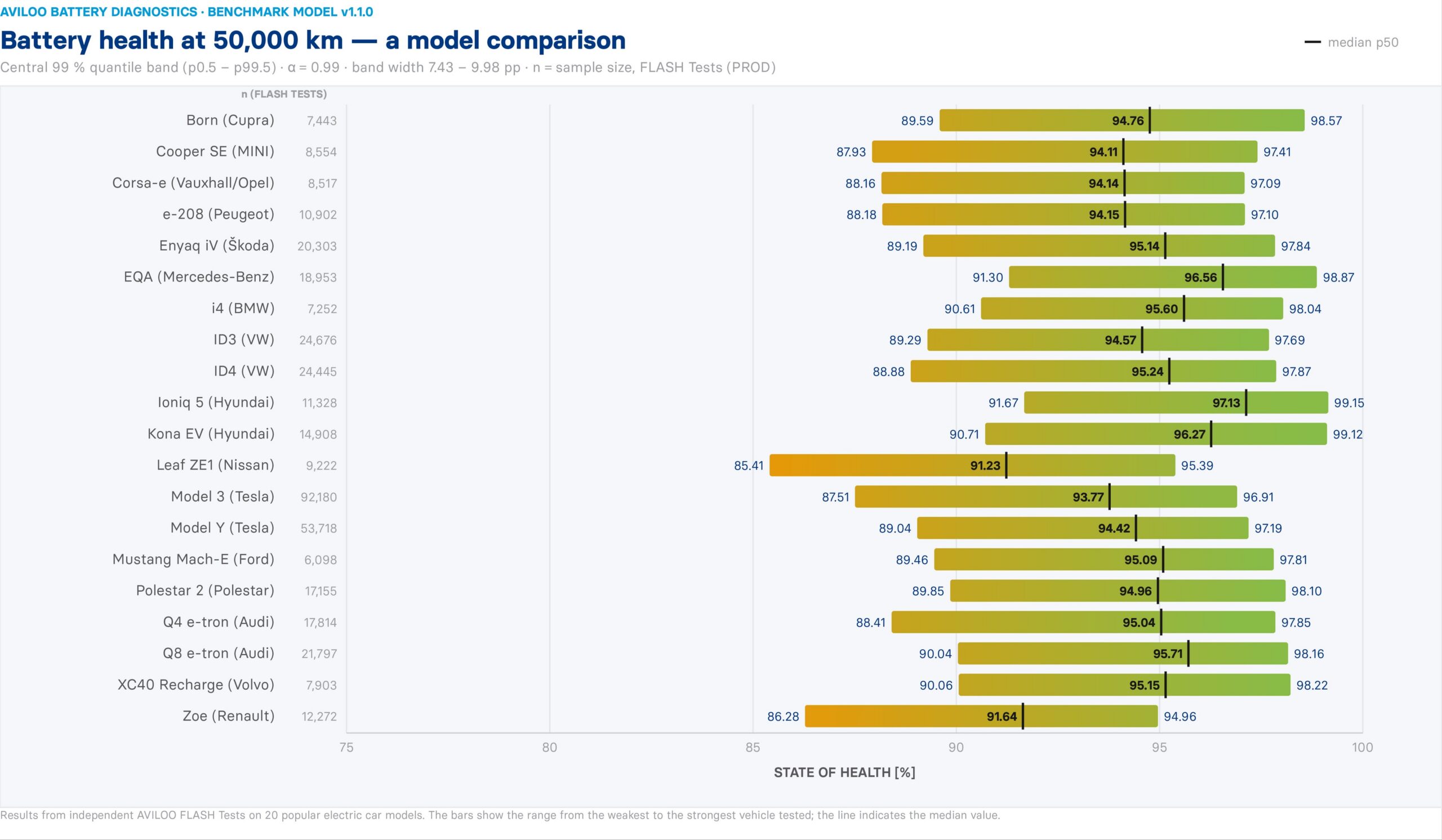
Up to a 13.5-point difference between cars of the same model.
AVILOO conducted rigorous testing between 2022 and 2026, evaluating 20 different models and analyzing the vehicle's usable capacity at the 50,000, 100,000, and 150,000-kilometer marks. The results are not based merely on the percentage displayed by the vehicle itself but are derived from independent diagnostics designed to assess the battery's actual condition and detect potential anomalies that might go unnoticed during a conventional BMS reading.
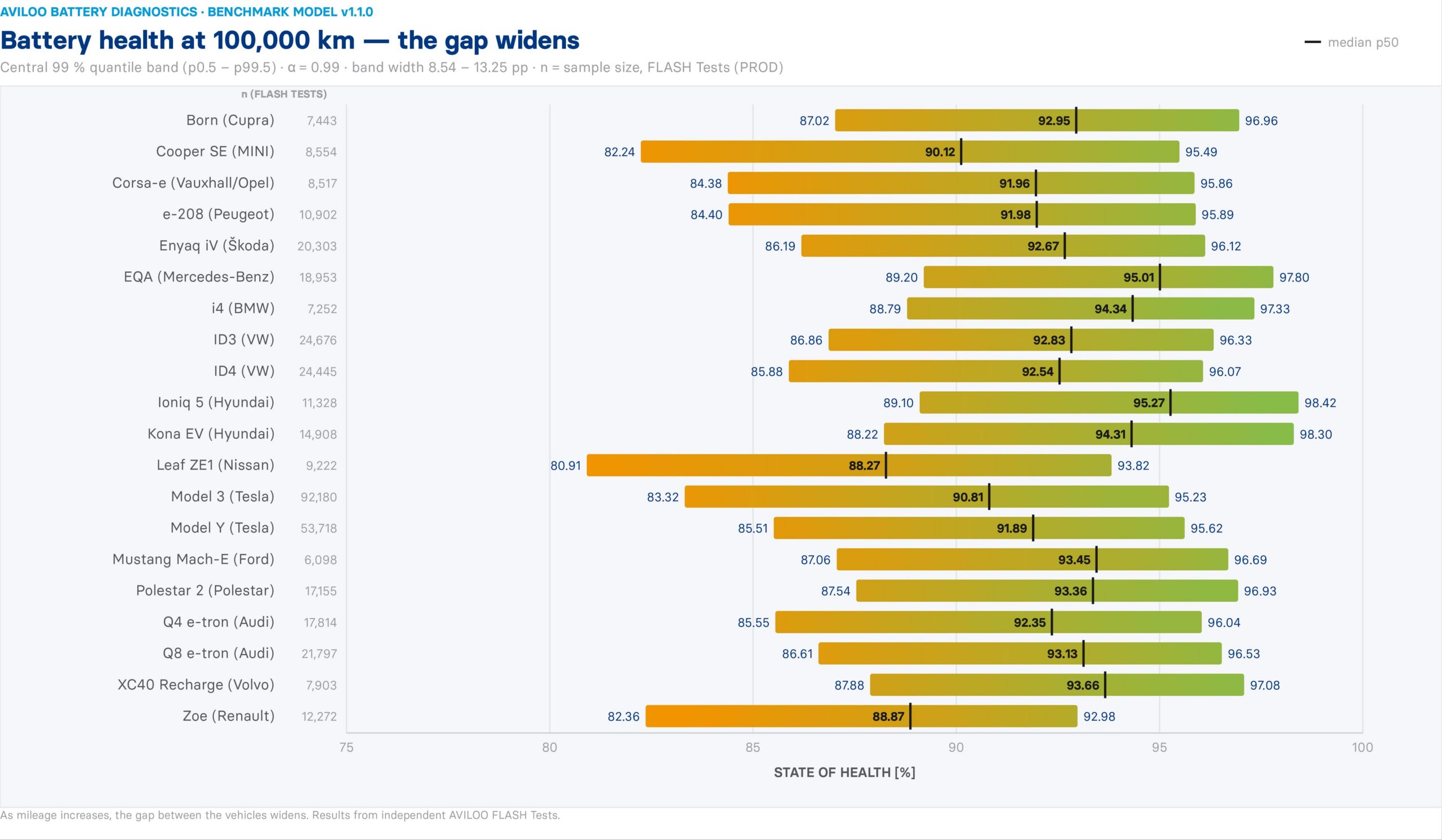
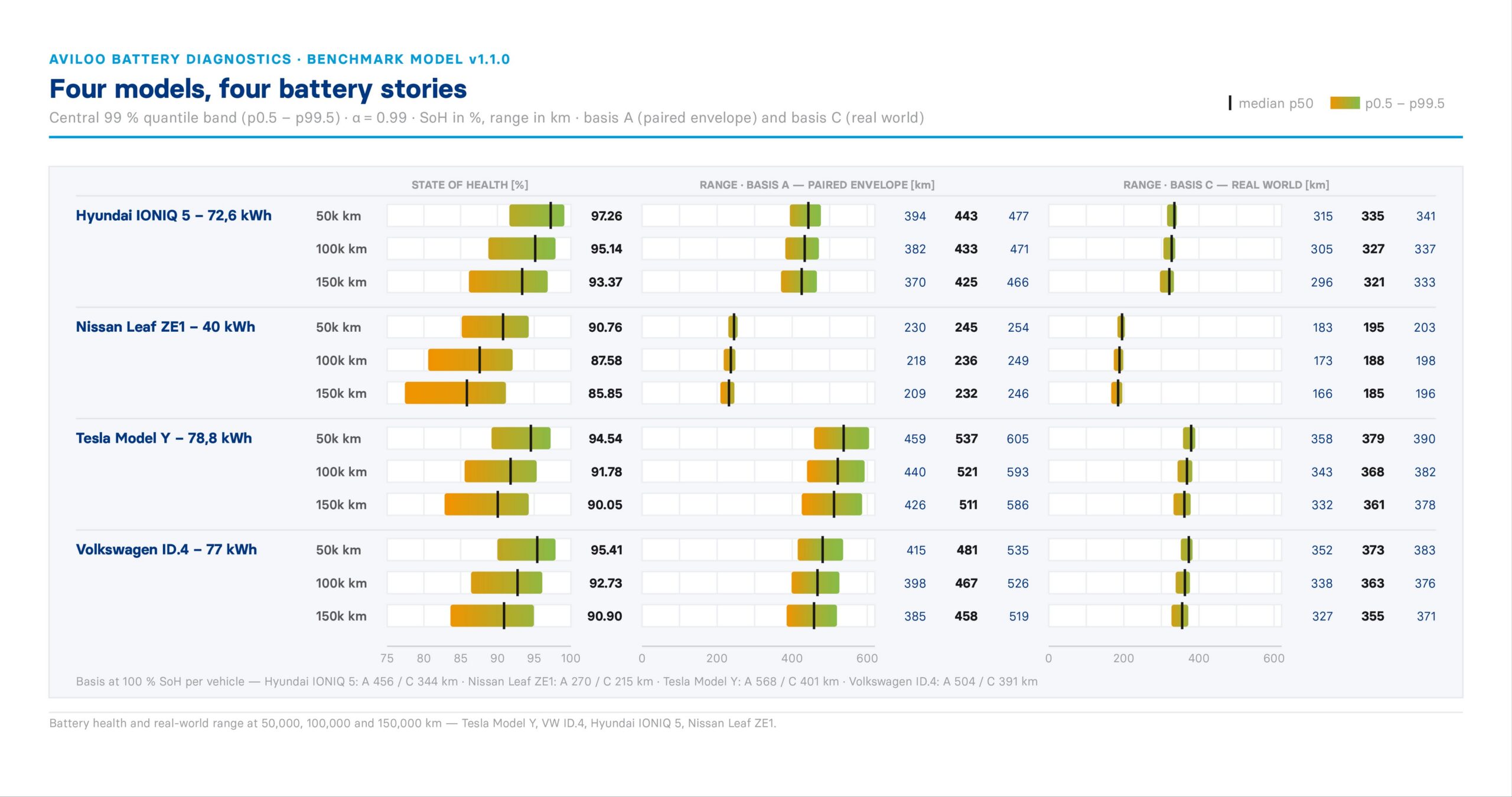
Analysis of the various models revealed that the Tesla Model Y shows an average SoH of 94.5% at 50,000 kilometers, retaining 90.3% at 150,000 kilometers. However, discrepancies of up to 11 percentage points were observed between individual units at that mileage—a difference AVILOO equates to a real-world range variation of approximately 47 kilometers per charge. The Volkswagen ID.4 and Hyundai IONIQ 5 show variations approaching or exceeding 12%.
The Nissan Leaf shows the greatest variation. On average, battery capacity remains at 86.3% after 150,000 kilometers, although the variation between different units can reach up to 13.5%. AVILOO notes that its lower capacity compared to other models analyzed requires a higher number of charging cycles to cover the same distance, which can contribute to cumulative wear.
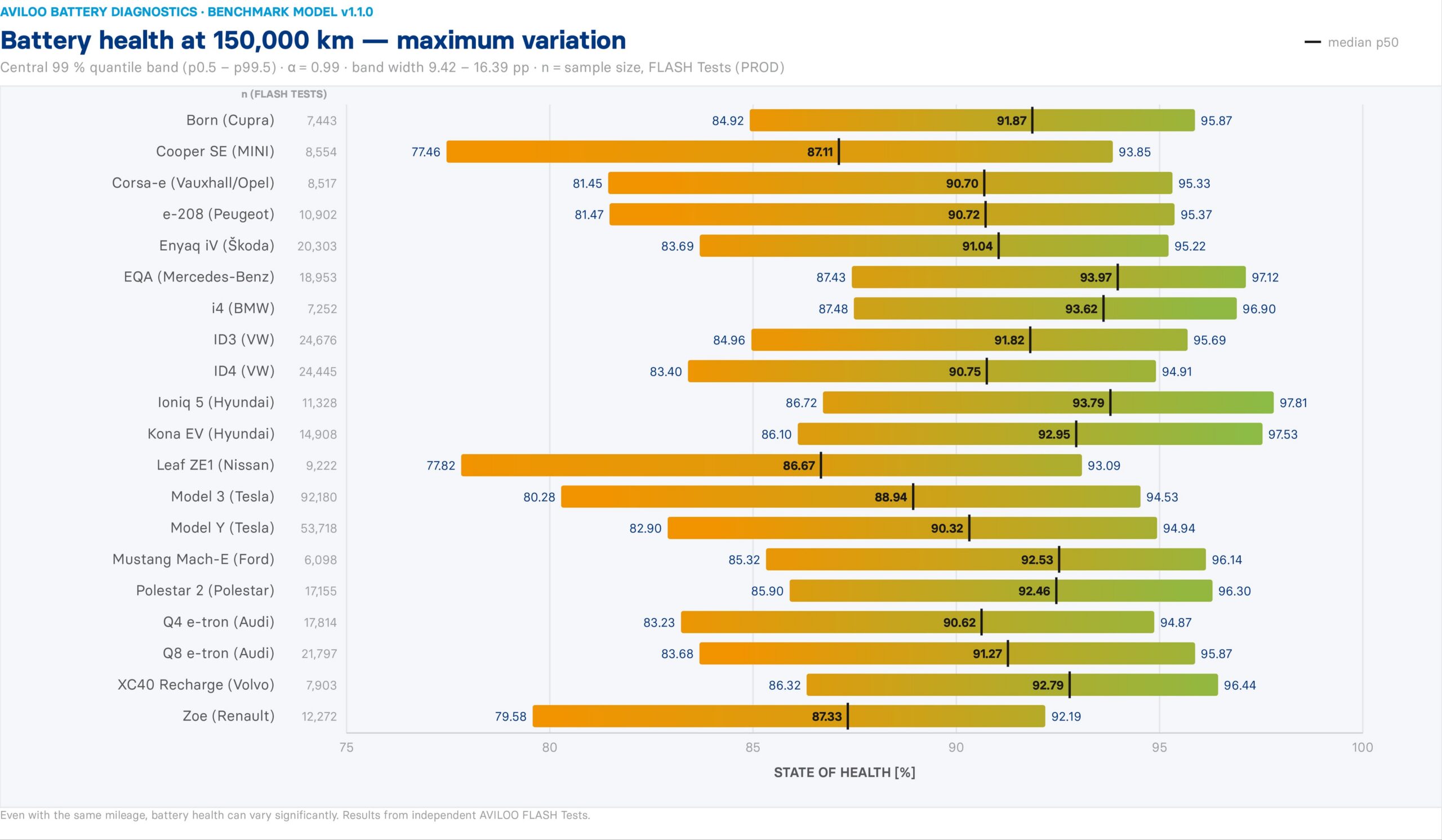
Mileage alone does not reveal the condition of the battery.
Data also show that average battery degradation is not particularly high across many of the vehicles studied. The challenge lies in applying these general figures to a specific car: factors such as age, charge cycles, temperature exposure, usage patterns, and cell-to-cell variations can result in two equivalent vehicles reaching the same mileage with vastly different states of health.
Consequently,
AVILOO advocates for the use of independent diagnostics when buying or selling
used electric vehicles. The FLASH Test—a comprehensive procedure requiring a
connection to the vehicle's diagnostic port for approximately three
minutes—evaluates multiple parameters before issuing a certificate. Notably,
the company points out that the State of
Such
checks are becoming increasingly important as the market for used electric
vehicles expands. AVILOO has tailored its systems for dealerships, fleets,
lease returns, and remarketing processes, acknowledging the battery's growing
role in determining each vehicle's residual value. A study analyzing over
500,000 vehicles confirms this hypothesis; the results indicate that two cars
with similar specifications and equivalent mileage do not necessarily share the
same battery condition.