


Download the audio
Slide 1. Introduction.
The class develops how after a certain mileage, the degradation of an electric vehicle’s battery increases, and the implications for fleet management.
Slide 2. The turning point in battery degradation.
- Battery health-SoH.
The durability of electric vehicle batteries is a critically important issue. Despite traditional beliefs, a study conducted by TÜV NORD in collaboration with Carly in 2026 has shown that these batteries have greater durability than expected.
The battery’s state of health is a key factor, particularly in the used electric vehicle market, as it represents the primary indicator of an electric vehicle’s remaining useful life. This report has examined the actual performance of batteries in electric and plug-in hybrid vehicles, and the results obtained are highly satisfactory.
- The key figure is 90,000 kilometers.
The study examined the state of health-SoH of the batteries in approximately 50,000 battery electric vehicles and plug-in hybrids, all of which were manufactured between 2016 and 2026.
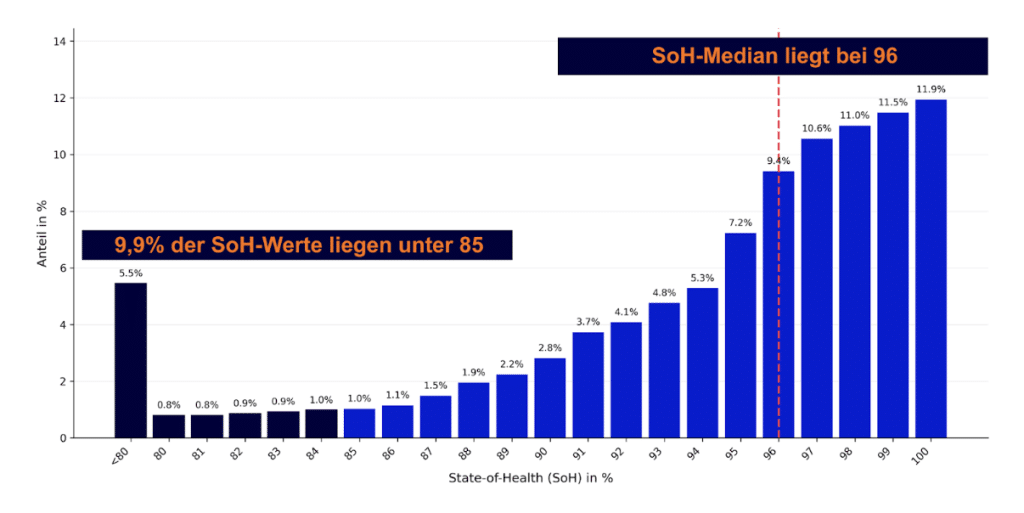
The main finding is that the median State of Health of the examined batteries stands at 96 points, indicating a significantly low level of degradation in most cases. In fact, only 9.9% of the vehicles have an SoH below 85 points, the threshold at which performance begins to deteriorate significantly.
Generally speaking, an SoH of 100 represents a battery in brand-new condition, while values above 90 are considered excellent and reflect minimal aging. In the 85 to 90 range, the battery exhibits adequate performance with moderate wear. However, when the level drops below 85, the impact on range and charging behavior becomes noticeable, which directly affects the vehicle’s resale value.
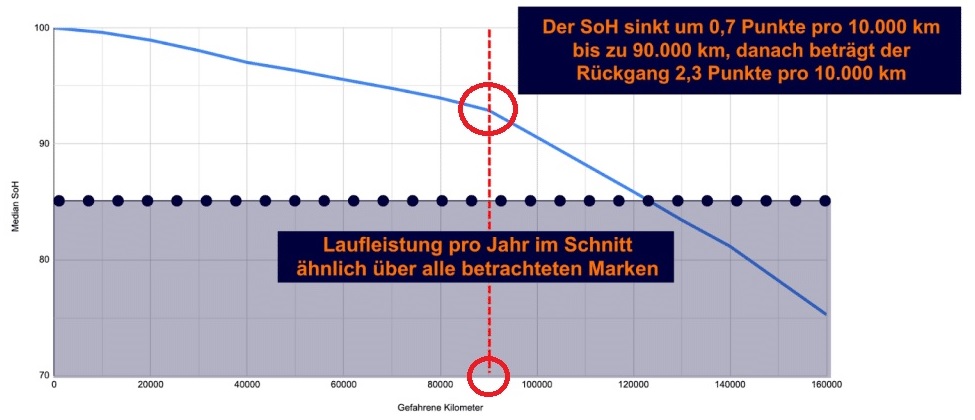
Several studies have shown that batteries hold up better than expected. However, the most significant finding of these studies has been the identification of a clear turning point in their degradation. During the first 90,000 kilometers, degradation is relatively limited, with an average loss of just 0.7 SoH points per 10,000 kilometers driven. However, beyond that threshold, deterioration accelerates significantly, reaching an average of 2.3 points per 10,000 kilometers.
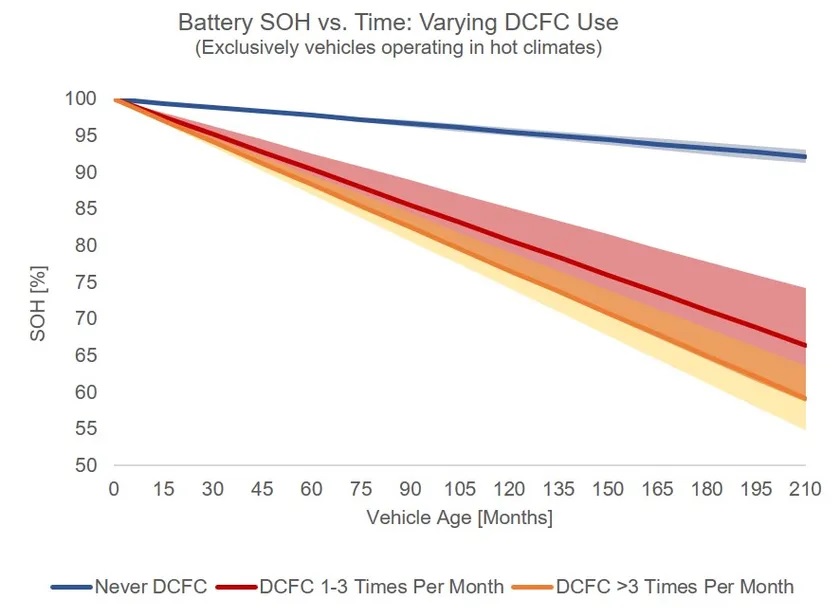
The study does not clarify whether mileage or the vehicle’s age has a greater impact on the decline in battery capacity. Furthermore, it is important to note that Carly and TÜV Nord do not address other factors that could influence the SoH beyond the brand, age, and mileage. For example, Geotab recently conducted an analysis concluding that frequent use of ultra-fast chargers instead of AC chargers slightly accelerates degradation, though within tolerable limits.
- Heterogeneous degradation by brand.
This pattern has been observed predominantly in newer vehicles, which account for the majority of the sample analyzed. Furthermore, the study indicates that annual mileage is fairly consistent across different brands, allowing for a comparison of results without this factor distorting the conclusions. In this regard, while notable differences are observed between manufacturers in older models, these differences are significantly reduced in newer vehicles.
Brands such as Hyundai, Kia, and Mercedes-Benz stand out for exhibiting high SoH values, even in older vehicles, with values ranging from 90 to over 95 points, and reaching nearly 100 in recent models.
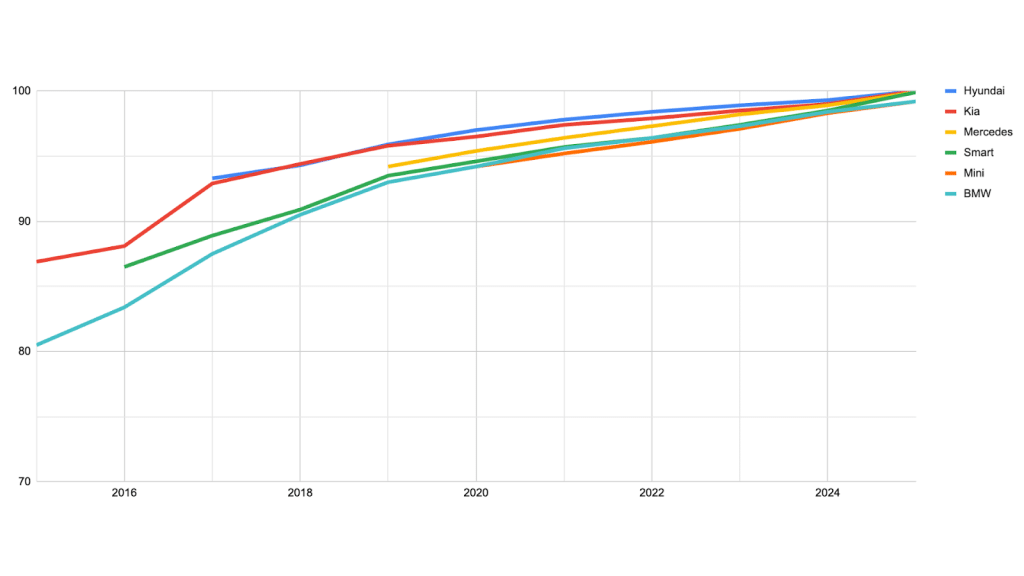
In contrast, manufacturers such as Volkswagen, Renault, and Citroën exhibit lower values in their older models, ranging from 70 to 80 points in some cases. However, as mentioned earlier, the gap narrows significantly in current models, where most brands achieve a score between 97 and 100 points. This reflects a general improvement in battery technology.
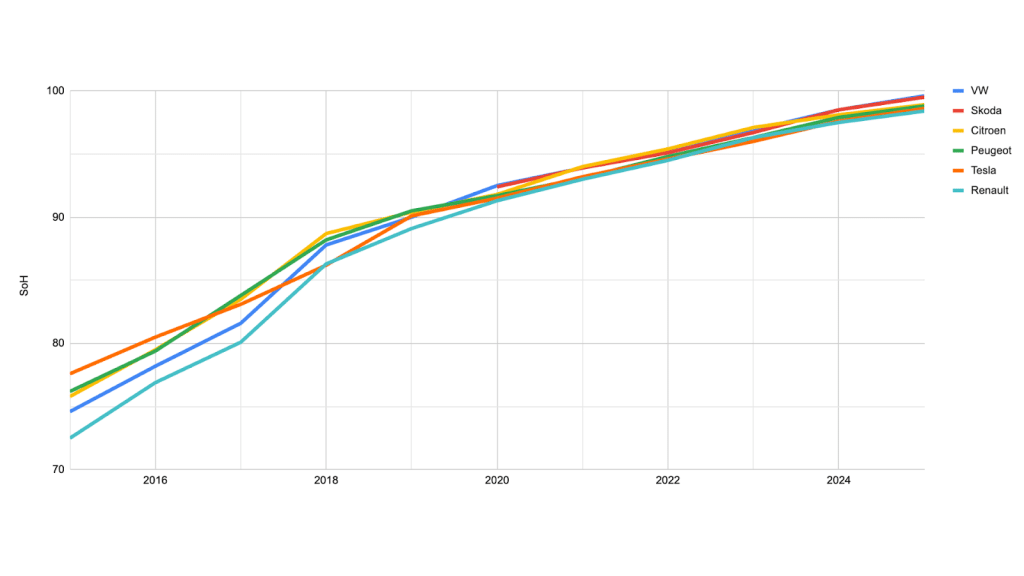
As a key finding, it is important to note that most batteries installed in electric vehicles have a significantly longer lifespan than previously estimated. Furthermore, it has been observed that the vast majority of new electric vehicles exhibit State of Health performance that exceeds the warranties offered by manufacturers. Currently, the market standard establishes a warranty of eight years or up to 160,000 kilometers, during which the battery must retain a minimum residual capacity of 70%.
- Implications for fleet management.
The main consequence is that there is a tipping point at which battery degradation accelerates, causing the vehicle’s range and residual value to decline more rapidly.
The following measures are recommended.
- Conduct our own study.
It is recommended to conduct our own study of battery degradation in our fleet vehicles to obtain valuable information for decision-making.
For example, by measuring battery health every 5,000 kilometers; if we have a large fleet, it is not necessary to do this on every vehicle, it can be done on 3 or 4 vehicles per model and make.
Keep in mind that different models and brands may use the same battery.
- Vehicle range.
The later the inflection point is reached, the better for our fleet.
We will understand how the battery degrades and at what mileage range begins to decline more rapidly.
We can estimate the mileage at which we will no longer have sufficient range to provide service, at which point we will need to purchase another vehicle.
- Vehicle resale.
One of the factors determining the resale value of an electric vehicle is the battery’s health.
After the tipping point, the vehicle’s residual value decreases more rapidly, so if we want to obtain the maximum resale value, we must sell the vehicle before the tipping point.
- Vehicle acquisition.
You can compare the inflection point across vehicle makes and models to choose those with the highest inflection point.
If purchasing used vehicles, you should always check the battery’s health.
Slide 3. Thank you for your time.
The class has developed how after a certain mileage, the degradation of an electric vehicle’s battery increases, and the implications for fleet management, see you soon.