

Download the audio
Slide 1. Introduction.
The class develops what a vehicle chassis is, its functions, types, maintenance, and potential MOT vehicle inspection faults.
Slide 2. The Vehicle Chassis.
- What is a vehicle chassis?.
The chassis ensures the driver's safety. It guarantees the vehicle's integrity in various situations. The strength and stability it offers increase passenger comfort while traveling on the road.
A vehicle's safety lies in its chassis, which forms the basis of its structure and provides support and impact resistance for every kilometer traveled.
The chassis is the vehicle's main support structure, providing support, rigidity, and shape, acting as the vehicle's internal skeleton. Side members and cross members are used to attach the vehicle's mechanical components.
- Functions of the chassis.
To delve deeper into the chassis's structure and understand its enormous importance, let's analyze the different functions it performs.
- Support the vehicle's total load.
This includes the weight of the occupants, luggage, the weight of the car's mechanical components such as the bumpers, fenders, engine, transmission, etc., and even the weight of towing equipment like trailers.
- Establish the surface and space where all the car's circuits will be mounted.
Its design and configuration are fundamental in determining the engine's orientation, whether longitudinal or transverse, and also in defining its dimensions, which in turn affects its power and displacement. Furthermore, the space available for installing electrical wiring and cooling system pipes must also be considered.
- Receive and withstand all stresses.
Generated by road irregularities such as potholes or uneven surfaces.
- Resistance to stress and strain.
It not only supports the weight of luggage, passengers, and vehicle components, but also absorbs impacts, sudden braking, and acceleration. Both front-wheel drive and rear-wheel drive cars generate torsion that the chassis must absorb. The vehicle is designed to withstand the stresses imposed by road conditions, ensuring a safe and comfortable ride.
To resist mechanical stress, the chassis is composed of materials with varying hardness and elasticity, strategically distributed in different areas of the vehicle. Steel alloys and other metals such as aluminum are commonly used. However, in certain sports cars or high-end vehicles, magnesium alloys and even carbon fiber can be found, used to reduce the vehicle's weight.
- Chassis Types.
There are different types of chassis. The most common are:
- Monocoque or Self-Supporting Chassis.
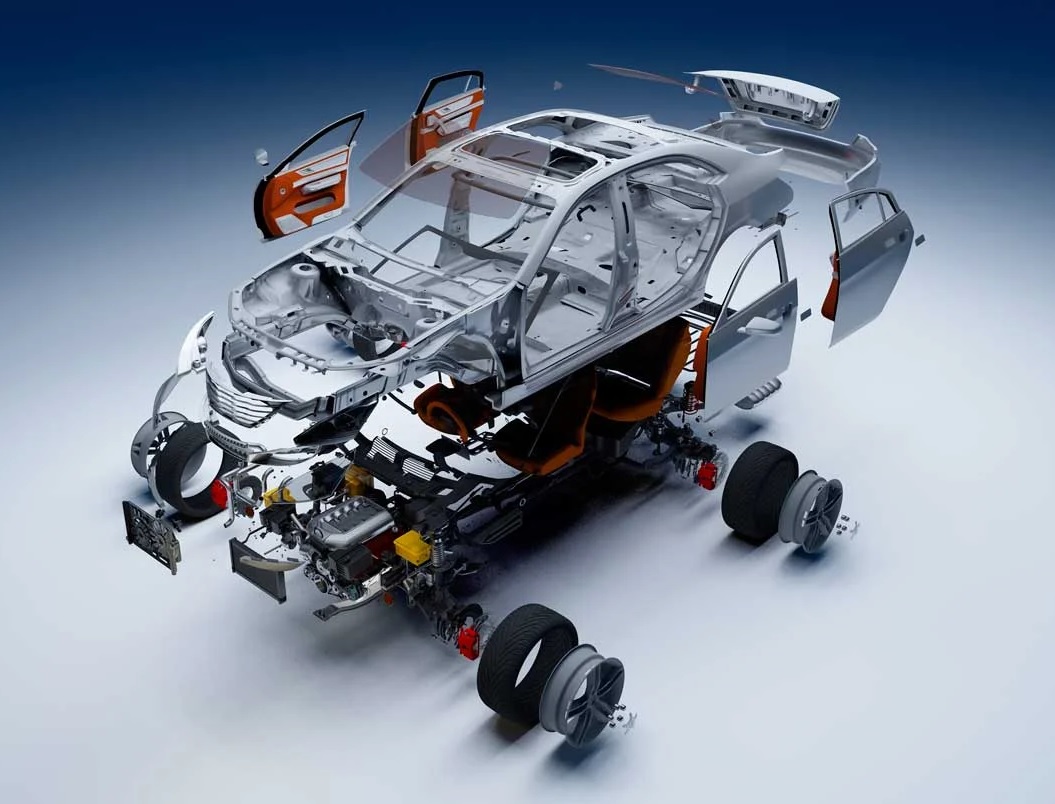
This consists of a set of crossmembers, longitudinal members, and components joined by welding, which form the vehicle's structure. The monocoque chassis is complemented externally by removable body components, such as the hood, passenger doors, roof, and trunk, among others.
Furthermore, it is important to note that the body is firmly welded to the chassis, allowing the latter to be removed from the chassis in case of a breakdown. This feature not only facilitates vehicle maintenance and repair but also optimizes the time and economic resources needed to carry out these tasks.
Currently, the vast majority of models from a single brand use the same chassis to mount the same suspension, engines, steering, or very similar gearboxes, while the body is the visual element of the exterior sheet metal that allows one model to be distinguished from another.
This chassis is generally used in light vehicles such as passenger cars and SUVs.
- Ladder or Independent Chassis.
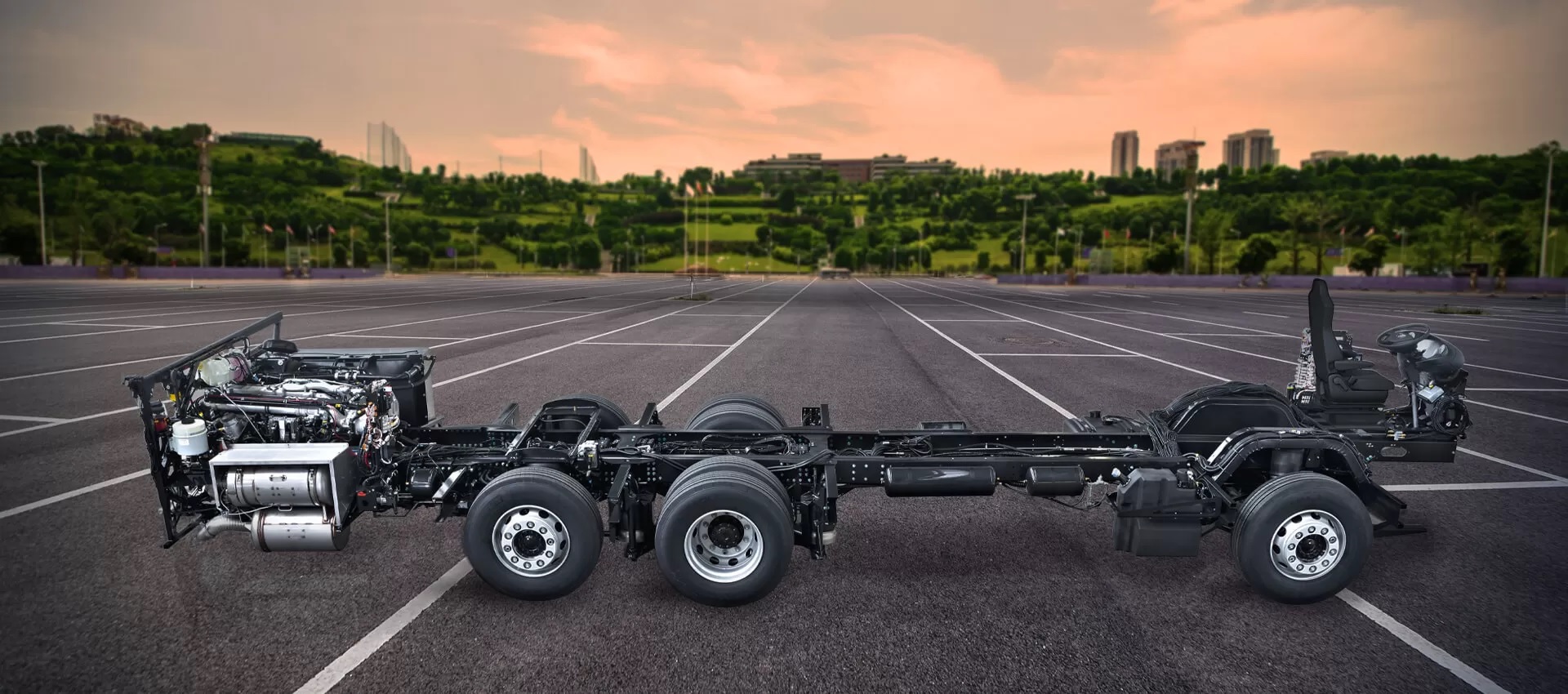
Also called an independent chassis. This chassis consists of two thick longitudinal beams welded to thinner crossmembers arranged transversely. The integration of these components results in a structure visually similar to a ladder, hence its name "ladder chassis." This type of chassis is used in commercial vehicles, buses, and off-road vehicles.
- Electric Vehicle Chassis.
The chassis of an electric vehicle constitutes the base structure or platform that supports the mechanical components, the battery, and the body. In contrast to internal combustion engine vehicles, this model integrates the battery in a lower position, resulting in a lower center of gravity, improved stability, and optimal use of interior space.
- Central Beam Chassis.
Also called a central tunnel chassis, this is a structure where a single central rigid tube, usually rectangular or cylindrical in cross-section, directly connects the front and rear axles.
The central tube acts as the vehicle's backbone, often housing the driveshaft. It lacks the parallel longitudinal and transverse members typical of traditional ladder frames. The body is mounted separately on this central structure.
Strict modern safety regulations in the event of a collision have led to its disuse.
- Tubular Chassis.
This is a geometric structure formed by multiple hollow steel or light alloy tubes joined by welding. Its design prioritizes the triangulation of forces to maximize structural resistance to torsion and bending while reducing weight. It is used in racing cars and classic sports cars.
- Carbon Fiber Chassis.
A carbon fiber chassis is the main structure or frame of a vehicle, made from a composite of fine carbon fibers bonded with resin. It offers superior strength to steel at a much lower weight, improving speed, safety, and fuel efficiency. Carbon fiber chassis are used in supercars and racing.
- Chassis Maintenance.
Given the diverse functions it performs, it is very important to pay attention to and maintain this component in optimal condition. This requires regular inspections and a thorough examination of its condition, identifying any signs of corrosion or structural damage, paying particular attention to exposed areas.
Periodic vehicle cleaning is essential to preserve the integrity of the chassis and prevent oxidation caused by exposure to salt and other contaminants.
Applying a protective coating is also crucial. These barriers act as an additional layer of protection, especially in areas prone to corrosion due to exposure to saline environments or humid climates.
Since chassis are designed to provide maximum safety within the vehicle structure, in the event of a serious accident, it is essential to assess whether this component has suffered any damage and determine its repairability based on any deviation, deformation, or breakage of its parts.
The situation is also influenced by the type of steel that has been damaged. The chassis is made up of various types of steel, some stronger and more elastic than others, which affects the ease of repair. If the chassis has suffered significant deformation, it is recommended to replace it with a new one or, alternatively, declare the car a total loss.
- Reasons for failing the MOT vehicle inspection.
The bodywork and chassis can be reasons for passing or failing the MOT. The presence of any rust, as well as cuts or sharp edges, must be checked.
It is important to note that any of these issues will be sufficient for a technician to deem your vehicle non-compliant. It is preferable to proceed in this way, as damage to the bodywork and chassis can cause significant structural damage to the vehicle.
Therefore, before going to the MOT station, it is essential to verify that the vehicle does not have any rust or sharp edges on the bodywork. Leaks in hydraulic circuits and problems in electrical systems will be classified as serious defects if they are numerous in the former and pose a risk of short circuits in the latter. Finally, poorly secured parts will also be considered serious defects if they pose a risk of detachment, and of course, the absence of a bumper or fuel cap.
Slide 3. Thank you for your time.
The class has developed what a vehicle chassis is, its functions, types, maintenance, and potential MOT vehicle inspection faults, see you soon.