

Download the audio
Slide 1. Introduction.
The class develops how to understand and resolve common issues with the MAF sensor, as well as the implications for fleet management.
Slide 2. MAF Sensor operation and faults.
- What is a MAF sensor?.
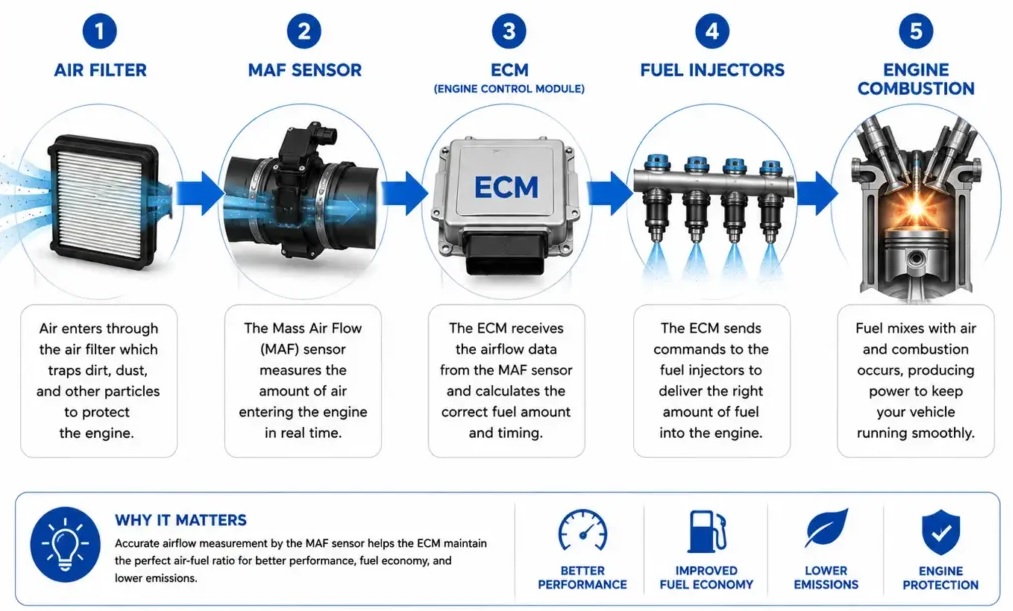
The MAF sensor plays a crucial role in accurately calculating the amount of fuel the engine needs to inject. It measures the mass of air entering the intake system and sends this information to the engine control unit-ECU.
If it becomes dirty or fails, the vehicle may experience increased fuel consumption, a loss of engine power, jerking or hesitation, or the illumination of the "check engine" light. Therefore, it is essential to understand its function and how to clean it without causing damage.
"MAF" stands for "Mass Air Flow." It is also commonly referred to as an airflow sensor or mass airflow meter.
Its primary function is to measure the amount of air entering the engine. Based on this data, the ECU adjusts the fuel injection to ensure efficient combustion.
If the reading is incorrect, the air-fuel mixture will be thrown off balance. The engine may run "lean" lacking sufficient fuel, leading to a loss of power or "rich" having an excess of fuel, resulting in higher consumption.
Cleaning the airflow sensor can often resolve issues caused by the accumulation of dirt, provided the problem is not due to an internal component failure.
- How does a MAF sensor work?.
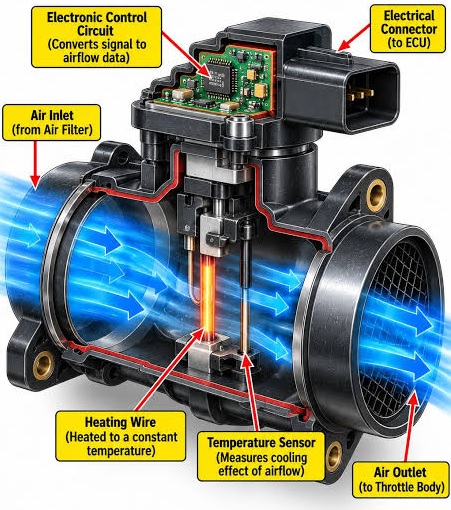
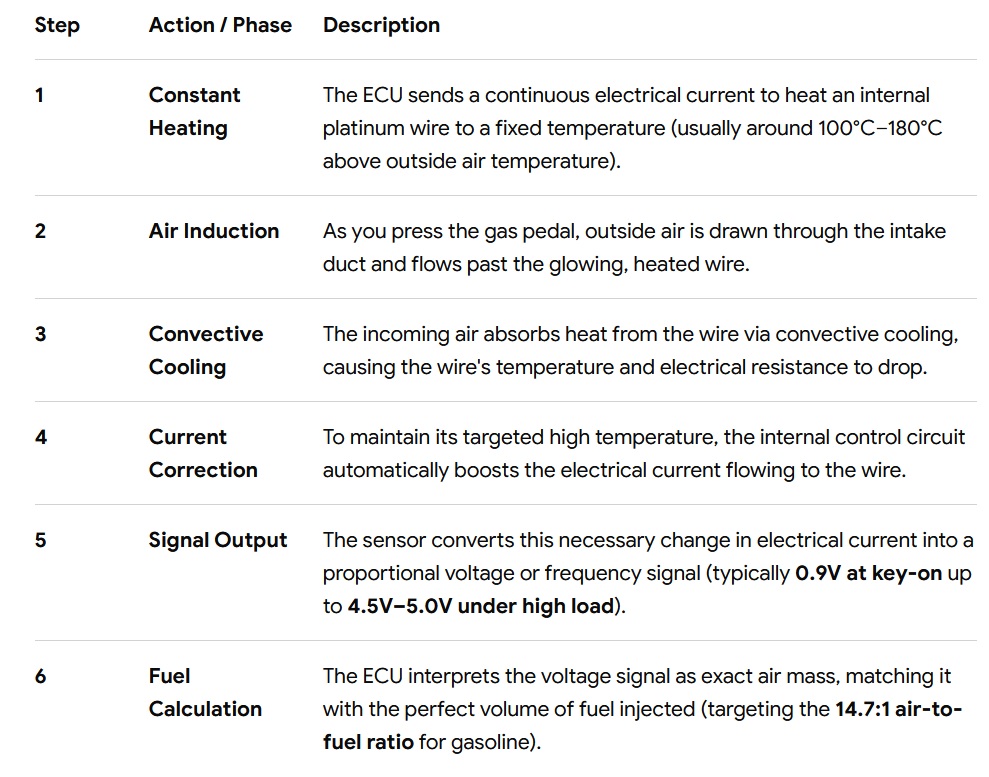
The most common design uses a "hot wire" or "hot film" element. The sensor maintains an element at a specific temperature and measures how much it cools down as air passes through the intake.
As the volume of incoming air increases, more energy is required to keep the element at a constant temperature. This process allows for the determination of the actual air mass, accounting for factors such as air density, temperature, and flow rate. This parameter is more precise than volume measurement, since cold, dense air does not behave in the same way as warm air.
- Why it is so important for the air-fuel mixture.
In gasoline engines, the engine control unit (ECU) aims for a ratio of approximately 14.7 parts of air to 1 part of fuel under ideal conditions.
If the MAF sensor malfunctions, the ECU will inject fuel based on incorrect data. This can lead to high fuel consumption, exhaust smoke, jerking, an unstable idle, or misfires.
It can also affect the catalytic converter, the lambda (oxygen) sensor, and other components of the emissions control system. It is worth noting that issues with the vehicle's oxygen sensor can sometimes be mistaken for a dirty MAF sensor, as both affect the air-fuel mixture.
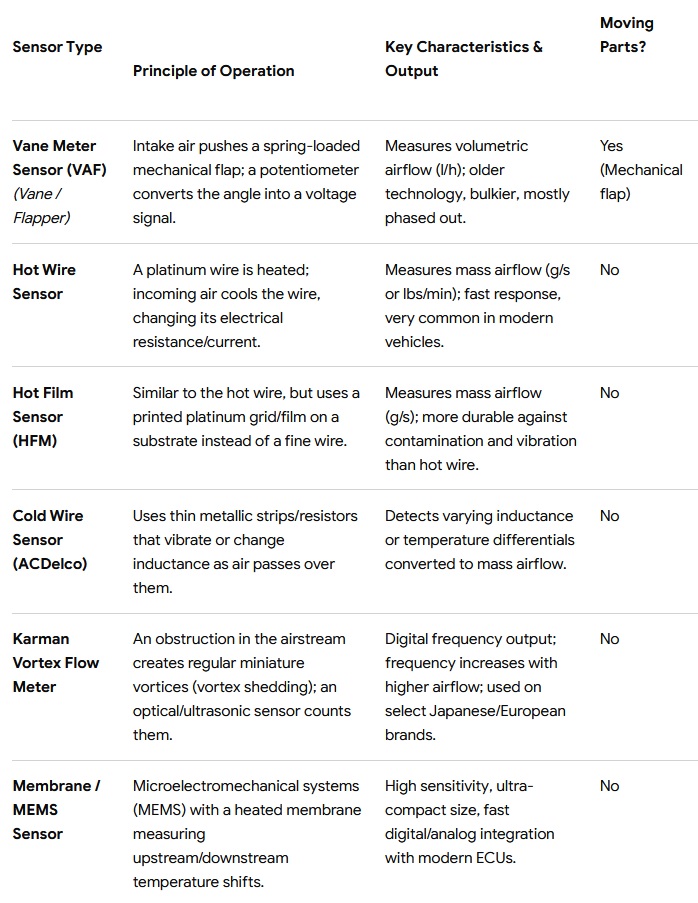
- Types of mass airflow sensors.
There are various types of sensors used to measure mass airflow; the most common ones are:
- Where is the MAF sensor located?.
It is generally located between the air filter housing and the throttle body or the intake duct.
It is typically mounted on a plastic tube and connected to the vehicle’s electrical system via a multi-pin plug.
Its strategic placement allows for the measurement of clean air immediately after the filter, ensuring accurate readings. If the filter is dirty, improperly installed, or of poor quality, the sensor can be affected and become contaminated prematurely.
Proper maintenance of vehicle filters is a key factor that directly influences both the lifespan of the MAF sensor and engine efficiency.
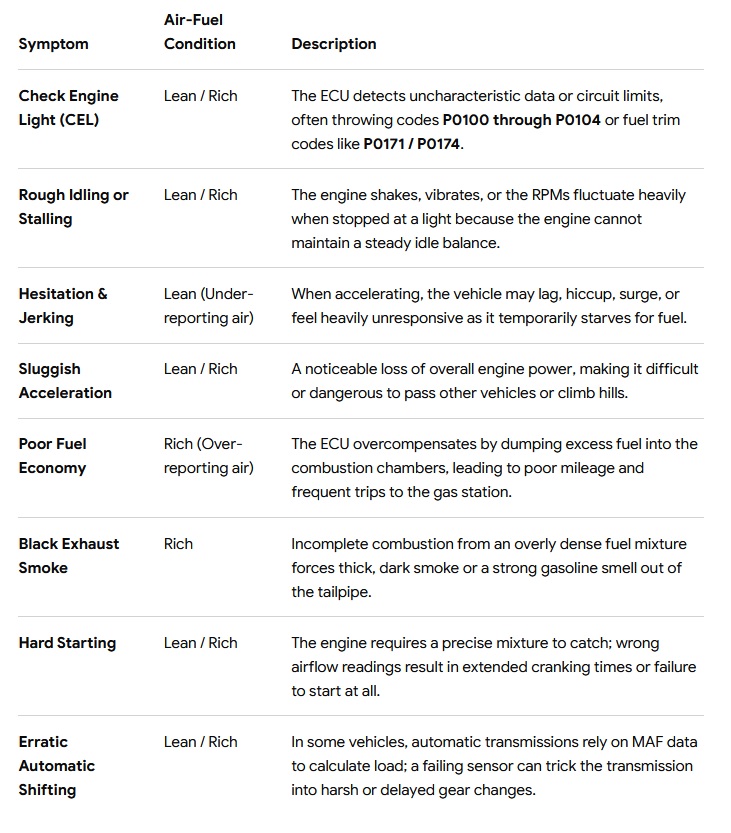
- Symptoms of a dirty or faulty MAF sensor.
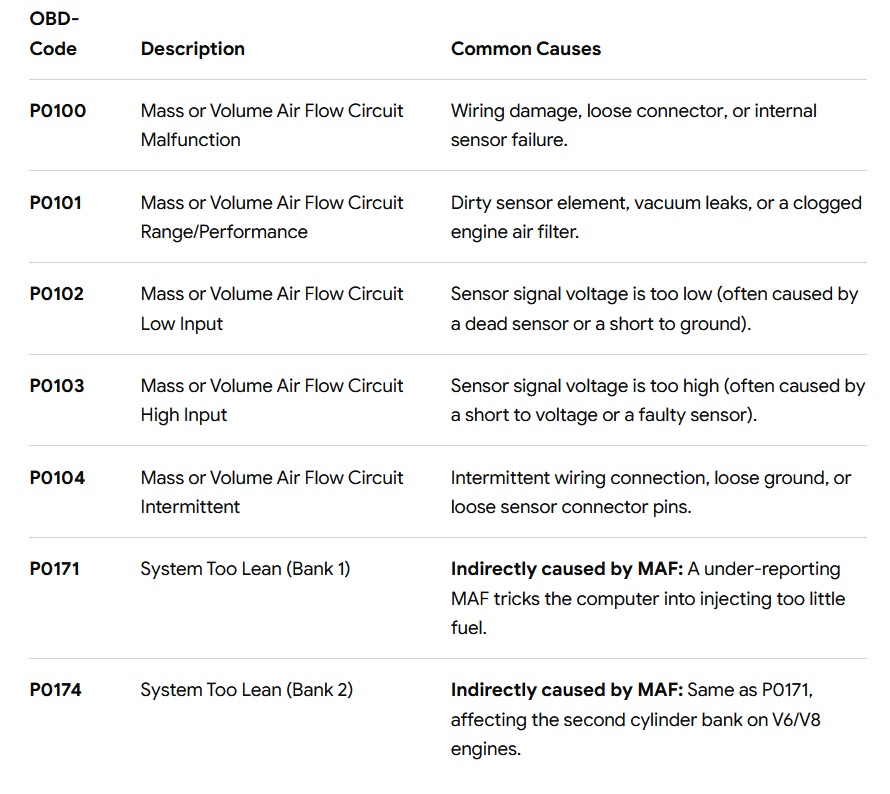
- Most common OBD codes associated with the MAF sensor.
The most common OBD codes associated with the MAF sensor are P0100, P0101, P0102, P0103, and P0104, although these may vary depending on the manufacturer.
If a warning light is triggered on the instrument cluster, the vehicle’s yellow warning lights can help gauge the severity of the issue before you head to a repair shop.
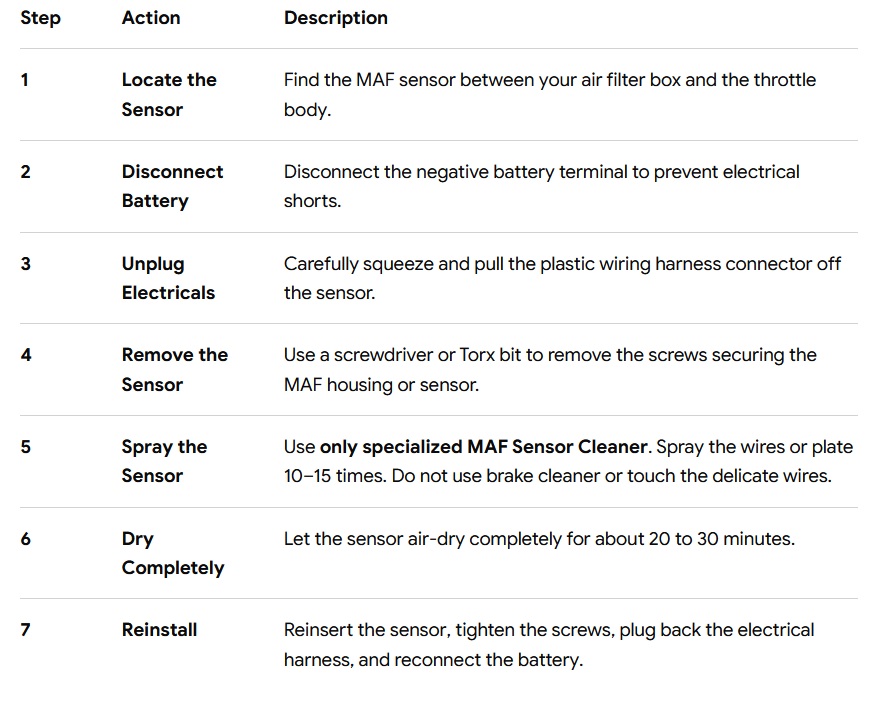
- How to clean the MAF sensor, step by step.
Before proceeding with any other steps, it is essential to turn off the engine and allow it to cool down to ambient temperature. Additionally, it is recommended to disconnect the battery, if advised by the manufacturer.
Next, locate the sensor, unplug the electrical connector, and carefully remove the unit. Take care not to pull on the wiring or apply excessive force to the plastic components.
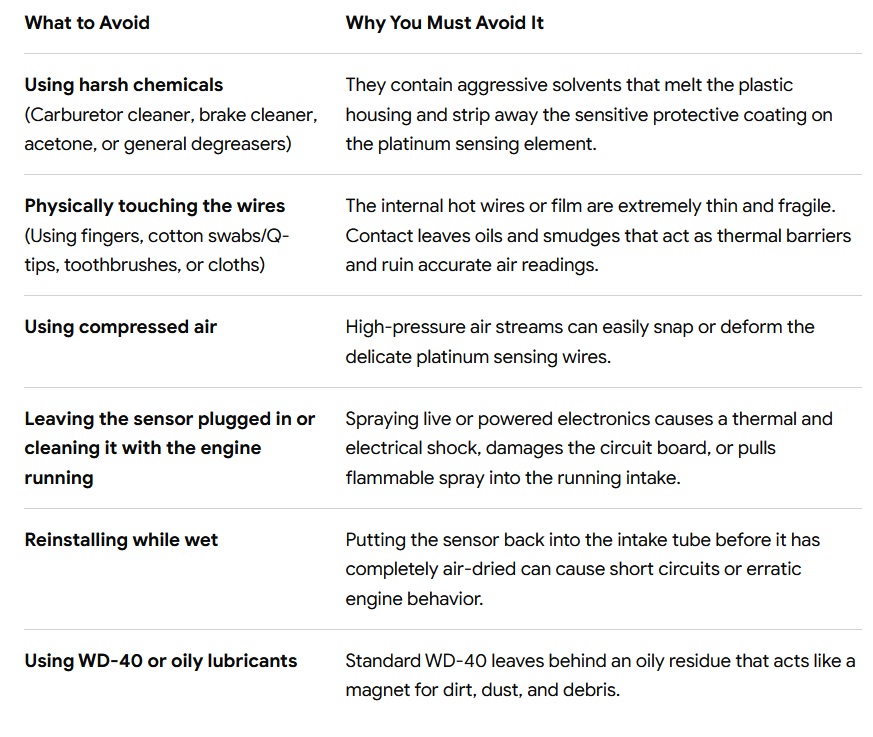
You must use only a cleaner specifically formulated for MAF sensor. The use of brake cleaner, gasoline, alcohol, water, or compressed air is strictly prohibited.
Spray the product onto the sensing element without making direct physical contact. Allow it to evaporate completely for several minutes, then reinstall the sensor, ensuring that all clamps or fasteners are securely tightened.
- What you should avoid doing during cleaning.
It is important to avoid rubbing the wire or the internal film during the process. This is an extremely fragile component that can be easily damaged.
Do not use compressed air to blow on the unit, as this can damage the sensing element.
Do not install the sensor while it is wet. It is essential that the product be completely dry before starting the vehicle.
Cleaning the MAF sensor is not recommended in the following cases: if physical deterioration is observed, if the connector is damaged or broken, or if a diagnostic evaluation reveals internal electrical faults.
- MAF, MAP, and EGR: faults that can be easily confused.
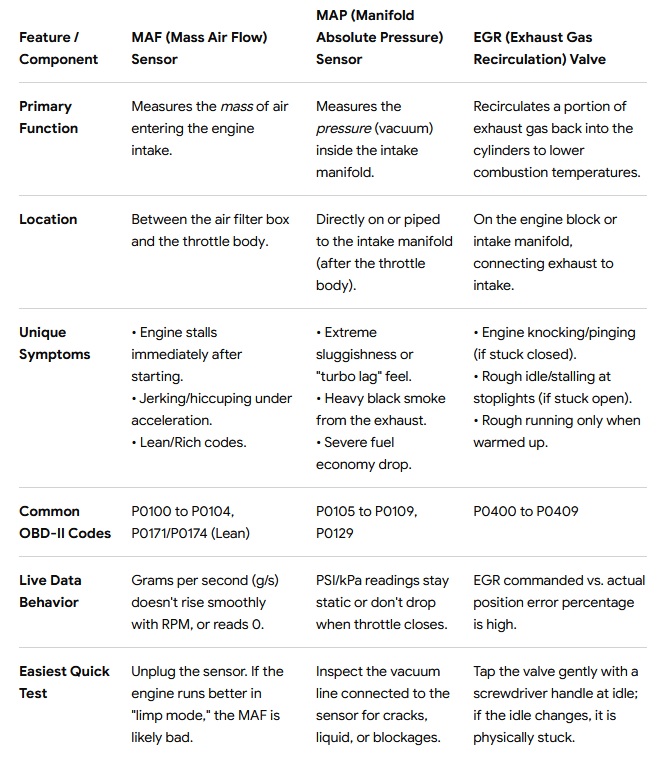
A MAF sensor fault can resemble other intake or emissions-related issues. The Manifold Absolute Pressure-MAP sensor, for example, measures pressure within the intake manifold and contributes to calculating engine load.
Therefore, before proceeding with the replacement of any parts, it is recommended to conduct a thorough assessment—including an inspection of the intake system, air filter, hoses, and the Exhaust Gas Recirculation-EGR system—as well as checking for any potential leaks.
The buildup of carbon deposits in the EGR valve can lead to a loss of engine power and trigger the corresponding warning light. These symptoms are similar to those caused by a dirty MAF sensor.
- When to replace the MAF sensor.
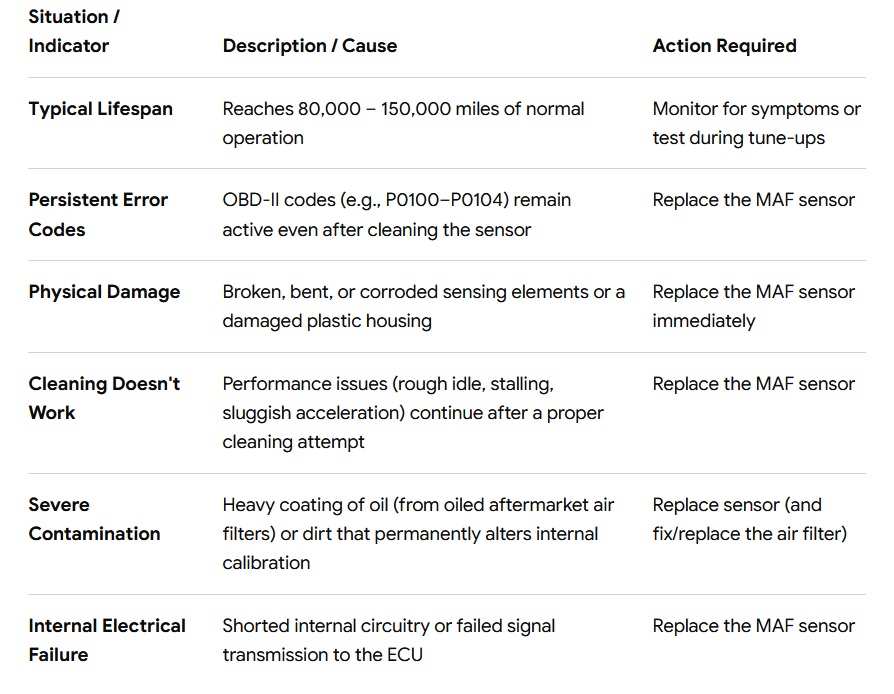
It is important to note that cleaning the sensor will only yield satisfactory results if the underlying issue is simply dirt or contamination. If the sensor is damaged, provides inconsistent readings, or fails to respond during diagnostics, it must be replaced.
Before purchasing a new unit, it is advisable to thoroughly inspect the wiring and the connector. Sometimes, the root cause may be a faulty electrical contact, an air leak, or an improperly installed air filter.
It is preferable to use an original MAF sensor—or one of equivalent quality—rather than a cheaper alternative that lacks precise calibration. It is worth noting that an incorrect replacement part can cause even more problems than the original, faulty sensor.
-
How to prevent malfunctions.
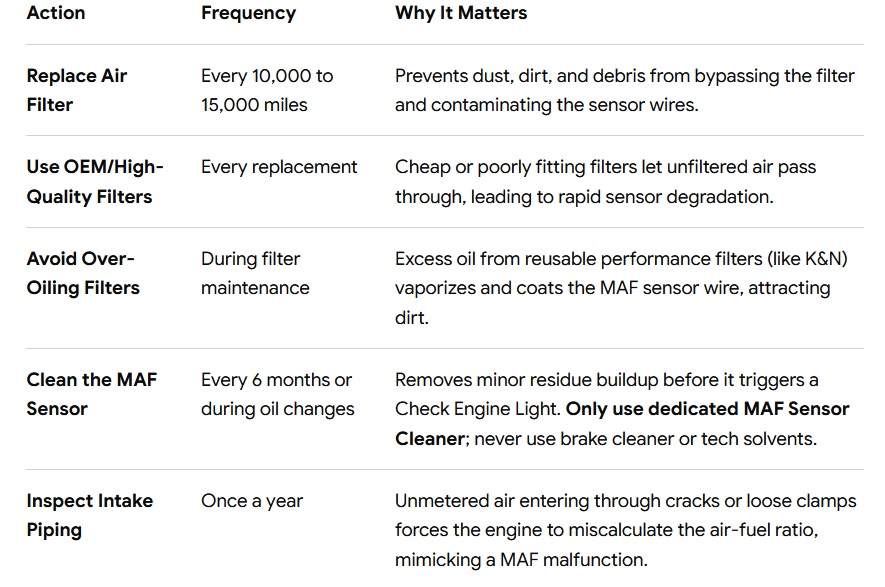
It is crucial to replace the air filter when necessary and to use appropriate replacement parts to ensure the system operates optimally. A poor-quality filter can lead to sensor obstruction due to the presence of particles.
Check that the air filter housing closes correctly and that there are no cracks in the intake ducts.
Avoid driving for extended periods if there are oil leaks or abnormal vapors in the intake system. Certain components, such as the PCV valve, can also be a factor if they allow an excessive volume of oil to enter the intake.
- FAQs about the MAF sensor.
- What happens if the MAF sensor fails?.
The engine may experience increased fuel consumption, a loss of power, jerking or hesitation, an unstable idle, or the illumination of the check engine light.
- Can the MAF sensor be cleaned?.
Yes, if the issue is caused by dirt. You must use a cleaner specifically designed for MAF sensors, and you should never touch the internal sensing element.
- Where is the MAF sensor located?.
It is generally located in the intake duct, specifically between the air filter housing and the throttle body.
- Is it better to clean or replace the MAF sensor?.
If it is dirty, cleaning it may be sufficient. If it has an electrical fault, provides inconsistent readings, or has sustained physical damage, it must be replaced.
- Can a dirty air filter damage the MAF sensor?.
Yes. A clogged, improperly installed, or low-quality air filter can allow dirt to enter the intake system, which can interfere with the sensor's readings.
- Implications for fleet management.
The main consequences of a dirty or faulty MAF (mass airflow) sensor include: increased fuel consumption, a loss of power, engine hesitation (jerking), an unstable idle, or the illumination of the check engine light.
The following measures are recommended:
- Vehicle maintenance.
Vehicle maintenance must be performed according to the manufacturer’s instructions and within the established intervals.
Diagnostics should be run via the OBD port to identify any error codes related to the MAF sensor.
Clean the MAF sensor once a year or every 15,000–20,000 kilometers to ensure it functions correctly.
- Air filter.
It is crucial that the air filter functions properly so that the MAF sensor can accurately measure the mass of incoming air.
- Premium replacement parts.
The MAF sensor is an essential component for engine performance and emissions control; therefore, it is recommended to use premium replacement parts—avoid using second-hand parts.
- Driver training.
Drivers should be trained to recognize signs such as increased fuel consumption, loss of power, engine hesitation, an unstable idle, or the illumination of the check engine light; they must report these issues to the workshop manager or fleet manager.
- Vehicle inspection-MOT.
If the MAF sensor is not functioning correctly, the vehicle will experience higher fuel consumption and increased pollutant emissions, which will cause it to fail the mandatory vehicle inspection-MOT.
Slide 3. Thank you for your time.
The class has developed how to understand and resolve common issues with the MAF sensor, as well as the implications for fleet management, see you soon.