

Download the audio
Slide 1. Introduction.
The class develops what ESP is, how it works, its components, common malfunctions, why it's so important for vehicle operation, and its implications for fleet management.
Slide 2. Why ESP is so important.
- What is ESP?.
The acronym ESP—Electronic Stability Program—dates back to the mid-1990s, when the German company Bosch developed this safety system, which was first integrated into the Mercedes-Benz A 140.
ESP is an advanced assistance system that uses a series of electronic sensors to improve vehicle stability. These sensors continuously monitor factors such as the vehicle's steering angle, wheel direction, and wheel speed. By collecting data approximately 25 times per second, ESP is able to quickly detect any indication of loss of control.
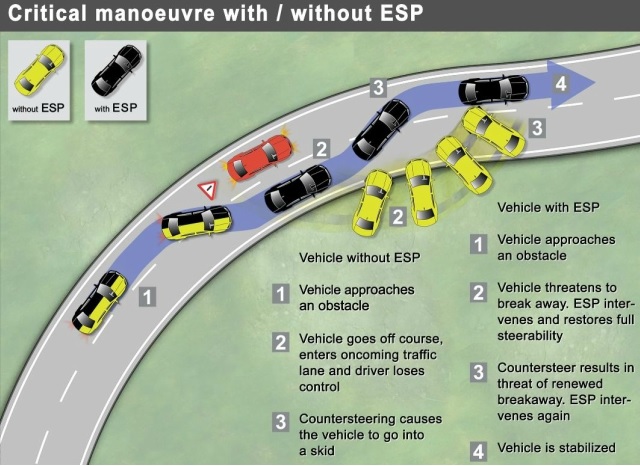
ESP will activate if it detects skidding or a loss of stability on sharp curves, during sudden changes of direction, on slippery surfaces, etc. Its function is to prevent the vehicle from leaving the road and the serious consequences that this would cause in many cases. According to certain studies, the Electronic Stability Control (ESC) system has reduced fatal accidents by 50%, resulting in the preservation of tens of thousands of lives worldwide.
It is important to note that many drivers do not perceive the small, constant interventions that their vehicle's ESP can make. Others notice its presence through the flashing indicator light on the instrument panel that identifies this safety system. After the seatbelt, it is arguably the greatest innovation in this field that automobiles have received. Furthermore, we must not forget the advancements that are emerging today with new driver assistance systems.
The European Union decided to make its inclusion mandatory in all new vehicles sold from November 1, 2014.
While European and North American models have incorporated ESP for years, it wasn't until 2018 that major Chinese manufacturers committed to including this essential safety feature in all their models.
- Advantages of ESP.
The advantages of ESP are as follows:
1. Accident Reduction.
As various studies have shown, ESP is extremely effective in reducing accidents caused by skidding and sliding. By automatically intervening to adjust the vehicle's trajectory, ESP can prevent accidents that could otherwise be fatal, especially on slippery road conditions or during rapid evasive maneuvers.
2. Rollover Prevention.
For taller and heavier vehicles, such as SUVs and vans, the risk of rollover is significantly higher. ESP helps reduce this risk by maintaining vehicle stability on sharp curves and during rapid lane changes.
3. Improved Tire Wear.
By preventing skidding and sliding, ESP also reduces uneven and premature tire wear, which can result in significant savings in tire maintenance and replacement.
4. Driver Confidence.
Knowing that a system with automatic intervention capabilities for correcting the vehicle's trajectory is available significantly increases driver confidence.
- Several acronyms for the same thing.
Although ESP-Electronic Stability Program and ESC-Electronic Stability Control are the most commonly used acronyms to refer to this system, some automakers have used, or still use, other names, such as:
- VSA-Vehicle Stability Assist.
- DSC-Dynamic Stability Control.
- DSTC-Dynamic Stability and Traction Control.
- VDC-Vehicle Dynamic Control.
- VSC-Vehicle Stability Control.
- VSE-Vehicle Stability Enhancement.
- PSM-Porsche Stability Management.
among others.
- ESP operation.
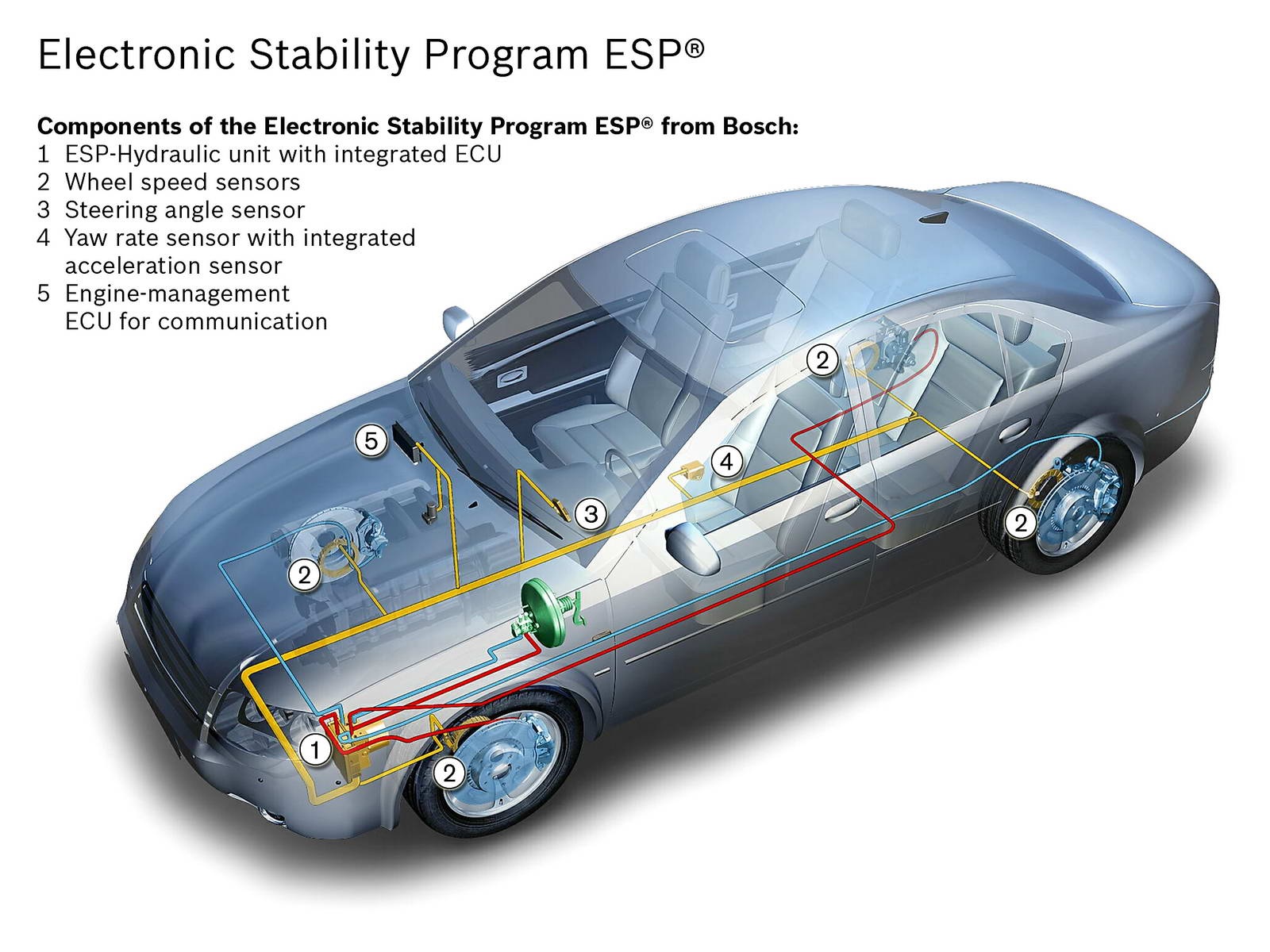
ESP works by integrating several key components:
1. Wheel speed sensors.
These sensors detect the rotation speed of each wheel, providing data that helps identify skidding or sliding situations.
2. Steering angle sensor.
This sensor measures the angle at which the driver is turning the steering wheel, which is vital in determining whether the vehicle is deviating from the desired path.
3. Lateral acceleration and “yaw” sensors.
These sensors monitor lateral acceleration, the vehicle's sideways movement, and yaw speed, rotation around the vertical axis, key indicators of vehicle stability.
4. Electronic control unit-ECU.
The ECU processes all the information received from the sensors and, if it detects a discrepancy between the direction desired by the driver and the current trajectory of the vehicle, it activates the system to correct the trajectory.
5. Action on brakes and engine.
If an unstable situation is detected, ESP is able to selectively apply the brakes to specific wheels and adjust engine torque to help maintain or regain control of the vehicle.
ESP uses ABS braking system components and multiple sensors that transmit a large amount of data in a fraction of a second. This data is analyzed by a control unit, which checks approximately 25 times per second whether the position of the steering wheel matches the actual direction of the vehicle. If the control unit detects that a certain deviation value has been exceeded in the vehicle's logical trajectory during a sudden maneuver, it sends a signal to a hydraulic device that activates the brakes on each wheel independently.
Therefore, if the direction taken by the vehicle does not match that indicated by the steering wheel, the system intervenes by braking the appropriate wheel and can even act on the engine to reduce its power. In order to guarantee tire adhesion and avoid pendulum effects with strong load changes, orders are issued that, in the first instance, produce a decrease in speed. This decrease facilitates the grip of the tires and, additionally, induces a turn with the non-steering wheels. The result of the above is taking control of the vehicle.
ESP doesn't work miracles either. You can control the car to a certain extent. If, for example, you go too fast in a curve, the control unit will control the speed of rotation of each wheel, but if they do not have grip due to that excess speed, the car will not be controlled and that is when you will have a problem.
- Reasons why the ESP warning light illuminates.
1. Faulty wheel speed sensor.
Stability control relies on sensors at each wheel. If one fails or gives incorrect readings, the warning light will illuminate.
2. ABS system failure.
Since it works in conjunction with the ABS, a fault in this system can directly affect stability control.
3. Problems with the steering angle sensor.
This sensor detects the direction the steering wheel is turning. If it fails, the system cannot calculate the actual trajectory.
4. Low battery or unstable voltage.
A weak battery can cause electronic errors and activate the warning light.
5. Steering wheel misalignment or mismatched tires.
Differences in size or wear between tires, or misaligned steering, affect its operation.
6. Electronic control unit (ECU) failure.
The control unit may have errors or lose communication with other systems.
7. Faulty acceleration sensor or gyroscope.
These sensors measure the car's movement. If they fail, this part cannot function correctly.
8. Deactivation button pressed.
Some cars allow manual deactivation.
- Is it dangerous to drive with the ESP warning light on?.
Indeed, driving with the ESP warning light on continuously can pose a safety risk, especially in adverse conditions such as rain, snow, ice, or sharp curves. This system helps maintain the vehicle's trajectory by selectively applying force to the wheels, allowing it to correct skidding or skidding.
If the light is on, it indicates that the system is deactivated or has detected a fault, meaning the vehicle no longer has this electronic assistance. Although the vehicle can be driven, there is a significant loss of active safety, increasing the risk of loss of control during sudden maneuvers or on slippery surfaces. In urban driving conditions with dry weather and at moderate speeds, the risk is low. However, it is strongly recommended to visit an authorized workshop as soon as possible for an accurate diagnosis and to restore the system to optimal operation.
The two exceptions in which it can be deactivated are:
1. Starting to drive on snow.
2. Driving in snow with snow chains.
- How to troubleshoot ESP faults.
Below are a series of vehicle maintenance recommendations to help resolve ESP-related problems.
1. Perform an OBD scanner diagnosis.
The first step is to connect a diagnostic tool to the vehicle. This will read the error codes stored in the control unit and show which component is malfunctioning.
2. Check the wheel speed sensors.
If any are dirty, damaged, or disconnected, they can cause errors in the system. Sometimes cleaning is sufficient; other times, they need to be replaced.
3. Check the steering angle sensor.
This sensor is located on the steering wheel and can become misaligned. It may require calibration or replacement.
4. Check the battery and electrical system.
A faulty battery or unstable voltage can trigger the warning light. Check and replace if necessary.
5. Check fuses and connections.
Blown fuses or loose connectors can cause intermittent errors.
6. Check tire condition and alignment.
Tires of different sizes, pressures, or uneven wear can interfere with the system readings. Proper wheel alignment and using compatible tires help prevent errors.
7. Replace or reprogram the control unit in severe cases.
If the ESP system's ECU is damaged, it may require replacement or reprogramming at a dealership or specialized workshop.
- How much does it cost to fix ESP?.
The cost of ESP repairs can vary significantly depending on the specific problem and the type of vehicle. Minor repairs, such as sensor recalibration, can range from 200 euros to 400 euros. If it is necessary to replace important components, such as wheel speed sensors, steering angle sensors, or the ESP control unit, the cost can increase to between 600 euros and 1,500 euros or more.
For high-end vehicles, the cost may be even higher. It is strongly recommended to visit a specialist workshop for an accurate diagnosis to determine the exact problem and to receive a proper estimate. Regular maintenance and preventative checks help reduce future repair costs.
- FAQs about the ESP warning light.
1. What does it mean when the ESP warning light comes on in my car?.
When the ESP warning light illuminates, it indicates that the stability control system is working to correct the vehicle's trajectory or that there is a system malfunction. If the braking system activates the warning light while driving, this is considered normal activation. If the light remains on continuously, this may indicate a problem requiring professional attention.
2. Is it safe to drive with the ESP warning light on?.
Driving with the ESP warning light on continuously is not recommended, as the stability control system may not be functioning correctly. This practice can increase the risk of losing control, especially in adverse weather conditions such as rain, snow, or low traction. It is strongly recommended to visit a specialized workshop for an accurate diagnosis and a thorough vehicle evaluation.
3. How do I turn off the ESP warning light?.
To turn off the ESP warning light, it is essential to identify and correct the root cause of the problem. This may require recalibrating the sensors, replacing faulty components, or performing an electrical system check. If the warning light remains illuminated, it is strongly recommended to take your vehicle to a garage for a more thorough inspection.
4. What does ESP OFF mean in my car?.
The ESP OFF indicator means that the stability control system is deactivated. This may have been caused by a manual deactivation via a button or by a malfunction. If the system does not reactivate or the warning persists, it is recommended to have your vehicle inspected.
5. How much does it cost to repair the stability control?.
The price varies depending on the specific cause. A recalibration or inspection may be less expensive, while replacing sensors, ABS/ESP modules, or electronic components may be more costly. It is strongly recommended to have your vehicle assessed before replacing any components.
6. Is ESP mandatory in current vehicles?.
Yes, as of November 1, 2014, all new vehicles sold in the European Union must include ESP as standard equipment. This system has proven effective in preventing accidents caused by skidding and loss of control.
- Implications for fleet management.
The main consequence of ESP malfunction is an increased risk of accidents, in addition to the vehicle being out of service and the cost of repairs.
The following measures are recommended:
1. ESP maintenance.
ESP maintenance must be performed according to the vehicle manufacturer's instructions and within the specified timeframe.
2. Driver training.
Drivers must be trained that ESP must always be engaged and never disengaged.
If the ESP warning light illuminates on the dashboard, the driver must notify our workshop manager or fleet manager, and the vehicle must not be used until it has been repaired.
3. Premium replacement parts.
ESP is a fundamental safety system. Always use original or premium replacement parts; never use low-quality or second-hand parts.
4. Remote diagnostics.
Using remote diagnostics, we can determine in real time if the ESP is malfunctioning.
5. Vehicle purchase.
In the European Union and the United States, ESP is mandatory. If ESP is optional in your country, it is always recommended to purchase it with your vehicle.
ESP is not a mere luxury, but a necessity in modern driving that significantly contributes to road safety. By providing superior control and stability, this system not only protects drivers and passengers, but also benefits other road users by reducing the likelihood of accidents. The inclusion of ESP as a standard feature in new vehicles reflects its importance and effectiveness, reaffirming its role as a pillar of active safety.
Slide 3. Thank you for your time.
The class has developed what ESP is, how it works, its components, common malfunctions, why it's so important for vehicle operation, and its implications for fleet management, see you soon.