

Download the audio
Slide 1. Introduction.
The class develops what ABS is in a car, its purpose, maintenance, malfunctions, and its implications for fleet management.
Slide 2. What is ABS?.
- Why is ABS so important?.
The Anti-lock Braking System, also known as ABS, is an active safety feature in vehicles that has been present on the market for several decades. The first vehicle to incorporate this system, patented by Bosch, was a 1978 Mercedes-Benz.
After an extensive period of testing and improvements, initially implemented only in luxury vehicles, it became mandatory in all new vehicles in the European Union in 2003.
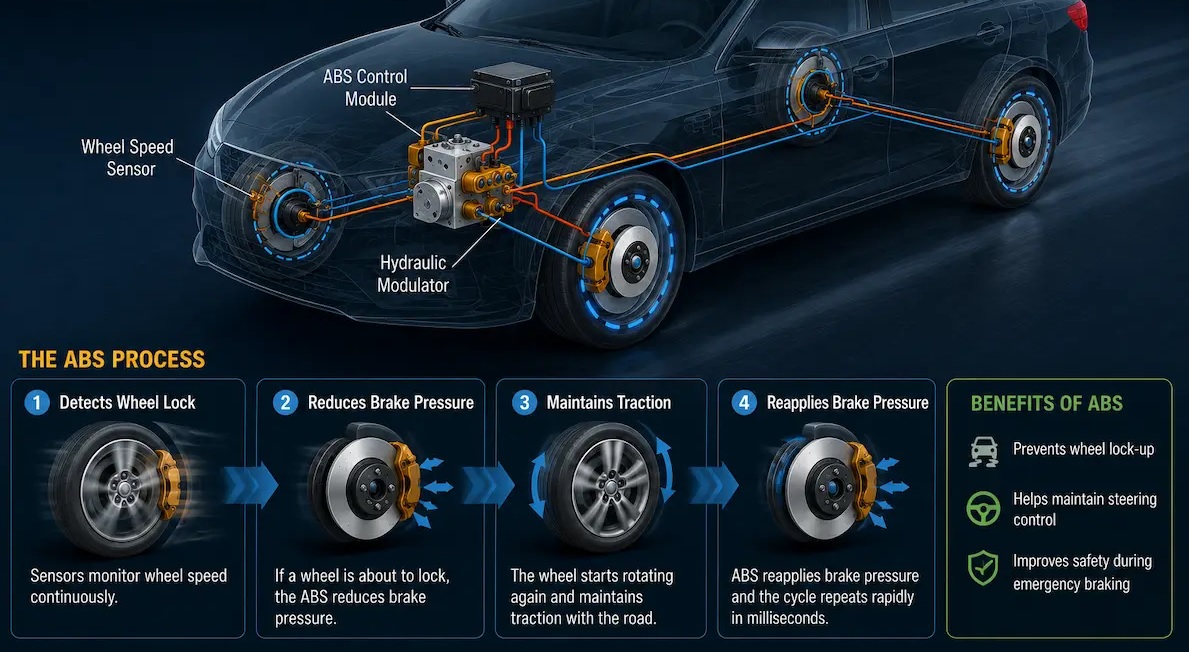
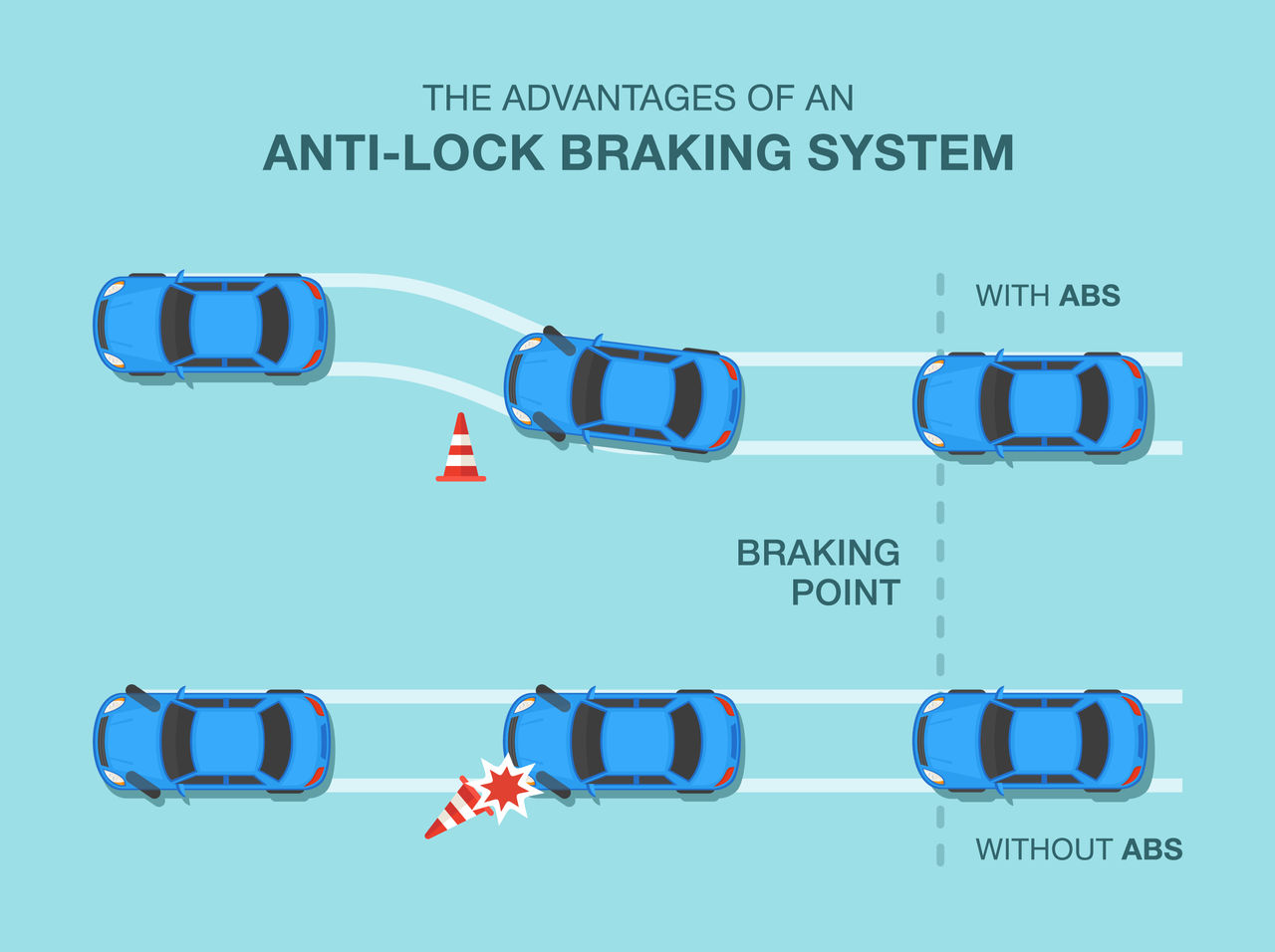
The main function of the anti-lock braking system (ABS) in vehicles is to prevent the wheels from losing traction and skidding, thus allowing the driver to maintain steering control. This is achieved through the integration of various components that make up this system.
If your vehicle is not equipped with an anti-lock braking system (ABS), during hard braking, the car will experience a loss of grip and will not respond adequately to steering inputs, compromising the driver's ability to maneuver around an obstacle.
- ABS system components.
- Wheel sensors.
These are located on each wheel of the car, allowing for precise measurement of the rotational speed of each wheel. On a curve, not all wheels rotate at the same speed; the inner wheels rotate at a lower speed than the outer ones. These sensors determine if the wheels are approaching the point of locking up.
- Control valves.
These allow for precise regulation of brake fluid pressure at each wheel, through the action of a piston, thus increasing or decreasing the wheel's rotational speed.
- Control unit.
This element of the system is responsible for collecting information from the sensors and determining the action to be taken on the control valves, acting in a matter of milliseconds to prevent the wheels from locking up.
- Components of a Conventional Braking System.
Brake fluid, brake lines, brake calipers, brake pads, brake discs, and master cylinder. If any of these components are not in good condition, the ABS system will not function correctly.
- How to brake when your car has ABS brakes.
The drawback of older vehicles that do not have an anti-lock braking system (ABS) is that the driver must manage the brake pressure properly. In the event of a wheel lockup, the driver is responsible for determining when to release the brake pedal and for how long to regain control of the vehicle.
In a vehicle not equipped with an anti-lock braking system (ABS), the most effective way to prevent the wheels from locking is by repeatedly and rapidly applying the brake pedal, releasing it continuously. However, this technique is not easy.
In a vehicle equipped with the ABS braking system, the control unit determines the amount of pressure applied to the brakes to prevent wheel lockup. The driver only needs to firmly press the brake and clutch pedals simultaneously, while the anti-lock braking system takes care of the braking.
If you feel a clicking or popping sound in the brake pedal and a slight rise and fall of the foot, do not panic and do not release pressure on the pedal.
- ABS system breakdowns.
This system is designed to withstand high mileage; however, various mechanical or electronic malfunctions may occur, depending on the affected component. The most common are listed below.
- Faulty wheel speed sensors.
If one of the sensors malfunctions, the ABS system will not accurately interpret the wheel speed.
- ABS control module failure.
This device manages and controls the rotational speed of the vehicle's four wheels. If the ABS system fails, it will either not work or will work incorrectly. It will likely need to be replaced.
- Problems with the reluctance ring.
The ABS system's reluctance rings generate electrical signals that are used by the speed sensors to accurately register each wheel rotation. If the sensors are corroded or damaged, the system will not accurately measure each time the tire completes a revolution.
- Control valve failures.
If these valves fail, the ABS system may activate when it is not needed.
- Problems with the hydraulic system.
While the anti-lock braking system (ABS) relies on the optimal functioning of the electrical system, if the mechanical parts, including the hydraulic system, are not in proper condition, braking capacity will be compromised, and the ABS will not function efficiently.
- ABS pump motor failure.
The anti-lock braking system (ABS) uses a pump to generate hydraulic pressure. If the correct pressure is not applied at the right time, the brakes will not release properly, which could result in the driver losing control of the vehicle.
- Problems with electrical connections.
If, over time, any wiring becomes loose or a short circuit occurs, the ABS brakes will not operate correctly.
- ABS maintenance.
To avoid the aforementioned malfunctions, it is essential to maintain the ABS brakes at the intervals recommended by the vehicle manufacturer. It is crucial to check the brake fluid level and ensure it is in optimal condition.
It is important that the system is free of any air bubbles, as otherwise, braking effectiveness will be compromised. Manufacturers recommend changing the brake fluid every two years to ensure optimal performance. However, it is recommended to consult the vehicle's manual for the recommended replacement interval.
A vehicle's anti-lock braking system (ABS) is a component that generally does not malfunction. If a failure occurs, the driver will be notified by a warning light on the dashboard indicating the system's condition. Should this happen, it is imperative to take the vehicle to a workshop as soon as possible, as other systems, such as traction control and stability control, could also be affected. In fact, in more modern vehicles, it may even be impossible to start the vehicle if an ABS failure occurs.
- How much does it cost to repair the ABS system?.
If the ABS brakes fail, it will likely be necessary to replace the valve body, the cost of which can vary depending on the vehicle model. Repairing this part involves an approximate outlay of 700 euros, while replacing the valve body costs approximately 2,000 euros or even more, considering that labor costs must be added to this price.
Another component that can malfunction is the sensor. In such a case, the cost of the valve body would be significantly lower, around 50 euros.
To prevent ABS system failure, it is recommended to have the vehicle inspected regularly and not postpone maintenance.
- Implications for fleet management.
The main consequence of an ABS failure is that the wheels may lock up during braking, resulting in loss of vehicle control and an accident.
The following measures are recommended:
- ABS Maintenance.
ABS maintenance must be performed according to the vehicle manufacturer's instructions and within the specified timeframe. The brake fluid must be changed as specified by the vehicle manufacturer.
- Driver Training.
If the ABS warning light illuminates on the dashboard, the driver must inform our workshop manager or fleet manager, and the vehicle must not be used until it has been repaired.
- Remote Diagnostics.
Using remote diagnostics, we can determine in real time if the ABS is malfunctioning.
- Premium Replacement Parts.
ABS is a fundamental safety system. Always use original replacement parts or parts from premium brands. Never use low-quality or second-hand parts.
- Vehicle Purchase.
In the European Union and the United States, ABS is mandatory. If ABS is optional in your country, it is always recommended to purchase it with the vehicle.
Slide 3. Thank you for your time.
The class has developed what ABS is in a car, its purpose, maintenance, malfunctions, and its implications for fleet management, see you soon.