

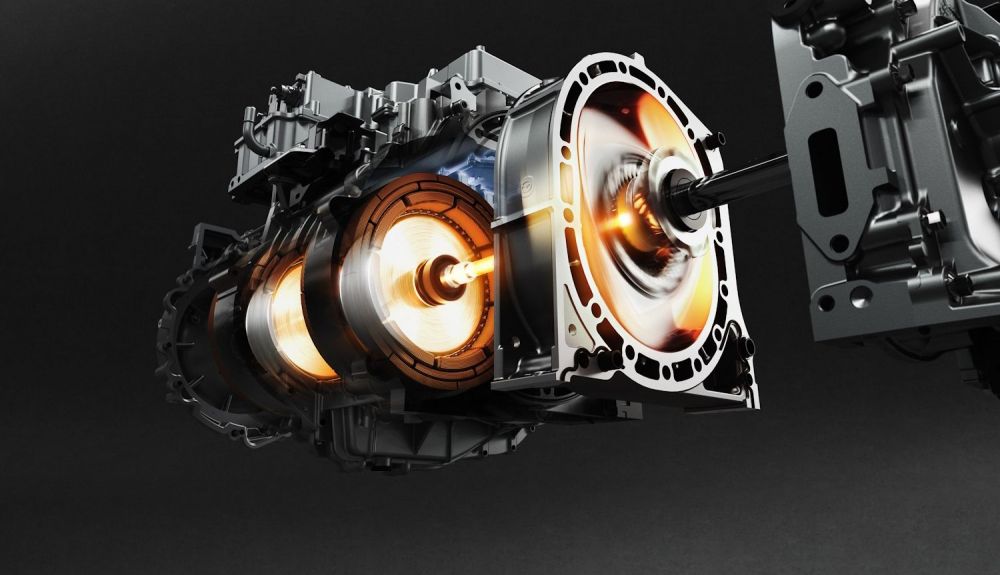
How the Mazda Wankel engine used in its electric cars works
The Wankel engine is an internal combustion engine that, unlike conventional engines, does not use pistons moving up and down; instead, it employs a triangular rotor that moves within an epitrochoidal housing. Its compact and refined architecture has enabled the creation of sports cars capable of high-revving performance. However, due to inherent challenges regarding sealing, fuel consumption, and emissions, the reciprocating engine remains the dominant choice in the market.
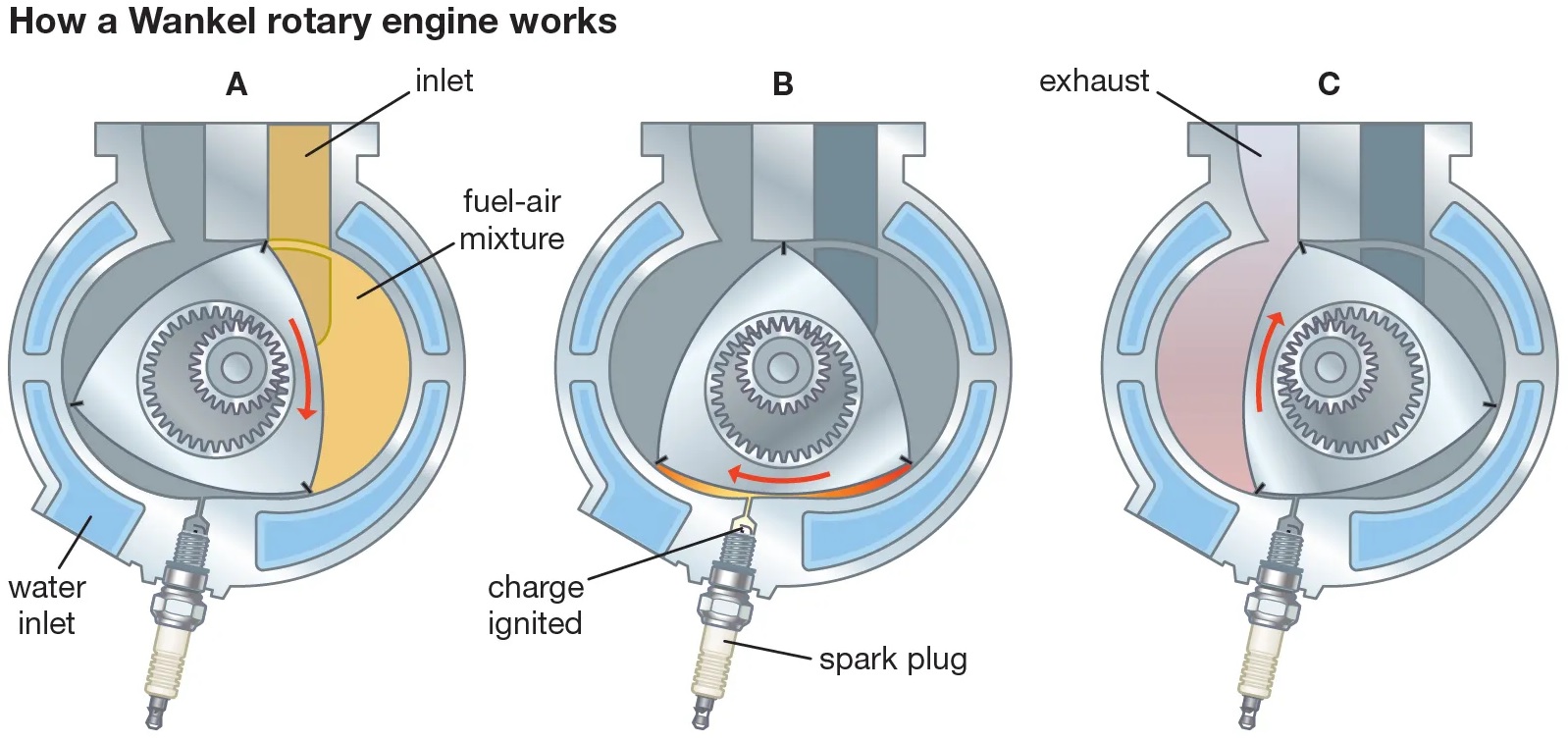
Its operation is based on the four fundamental phases of any internal combustion engine: intake, compression, combustion, and exhaust. The difference lies in how the chambers are formed, how power is transmitted, and the simultaneous occurrence of various phases in different zones of the housing.
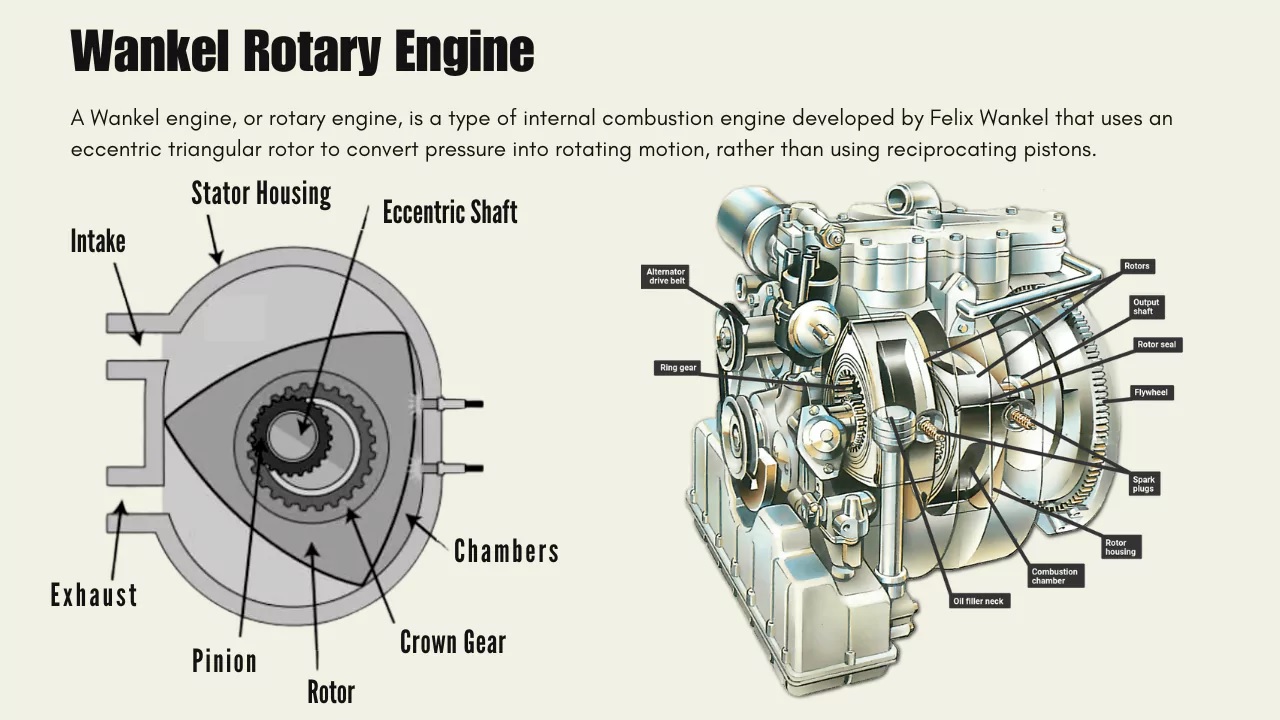
Components replacing pistons, connecting rods, and valves.
- Rotor, housing, and eccentric shaft.
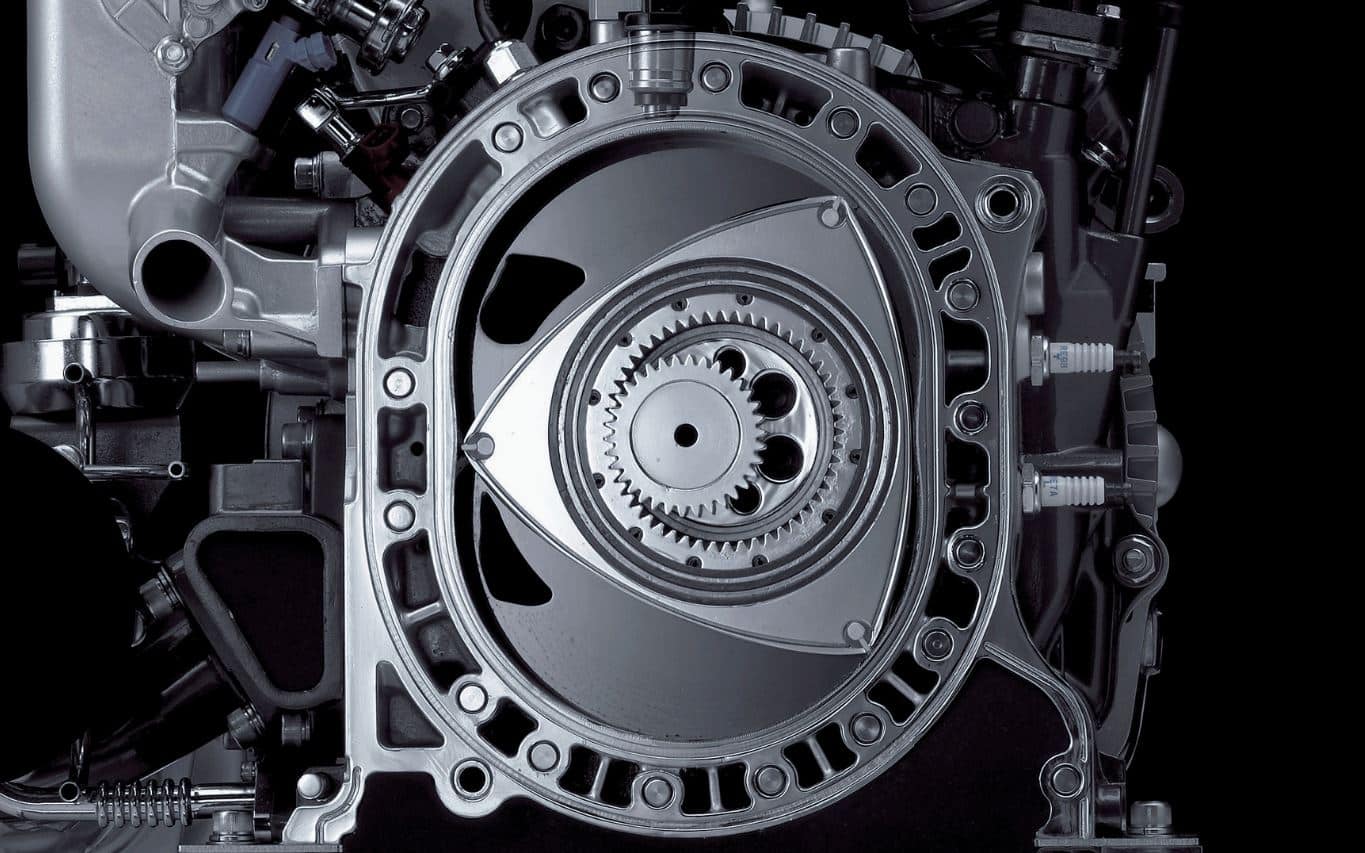
The rotor features three faces and rounded vertices. It moves inside a housing with an inner wall shaped like an epitrochoid curve. A chamber is created between each face and the housing wall; the volume of this chamber fluctuates as the rotor moves. The rotor's motion is not merely a simple rotation around its own center; it also involves an orbital movement component, guided by a fixed gear.
An eccentric element is located at the center of the shaft. This element receives the thrust from the rotor and delivers the usable output motion, thereby performing a function comparable to that of a crankshaft. The Wankel engine dispenses with conventional components such as connecting rods, camshafts, and valves—maintaining a simplified design—yet it still requires an output shaft and does not convert combustion into rotation without an intermediary component.
- Ports, spark plugs, and seals.
The fuel-air mixture enters, and exhaust gases exit, through openings or ports located in the housing or the side plates. As the rotor moves, it automatically and efficiently seals and closes the ports, thereby eliminating the need for a valvetrain. The combustion chamber features a long, narrow configuration; consequently, many designs incorporate two spark plugs to accelerate and stabilize the flame front.
Apex seals, strategically positioned at the three vertices, ensure separation between the chambers. These are complemented by side and corner seals, guaranteeing comprehensive sealing. Maintaining a tight seal is crucial; wear or damage leads to a loss of compression, which can cause starting difficulties, power loss, or even irregular combustion.
The four phases of the cycle.
- Intake and compression.
When a vertex uncovers the intake port, the chamber volume increases, allowing the air-fuel mixture to enter. As movement continues, the port closes and the chamber shifts toward the area of minimum volume. The mixture is compressed against the housing wall, without the need for a piston rising inside a cylinder.
- Combustion, expansion, and exhaust.
Near the point of minimum volume, the spark plugs fire to initiate combustion. The expansion process exerts pressure on one face of the rotor, causing the eccentric shaft to rotate. Subsequently, the exhaust port opens, allowing gases to be expelled as the volume decreases. Each face repeats the process; while one chamber handles compression, another manages intake, and a third handles the exhaust phase.
The rotor spins at a lower speed than the eccentric shaft. In the standard Wankel configuration, one full rotation of the rotor corresponds to three revolutions of the shaft. This relationship, in conjunction with the phase overlap between faces and rotors, explains the uniform power delivery and the ability to reach high speeds without reciprocating masses changing direction.
Why it is so appealing.
Its main advantage is compactness. A single- or twin-rotor assembly—thanks to its versatility and ease of integration—can be installed in tight spaces and rearward positions, benefiting mass distribution. Because it lacks pistons that must stop and reverse direction during every stroke, operation is smooth and allows for high engine speeds with fewer moving parts in the valvetrain.
For decades, Mazda has cemented these qualities as part of its corporate identity. The transition from the Cosmo Sport to the Mazda RX-7 illustrates how a smaller engine can contribute to a lightweight front end and agile performance. Later, the Mazda RX-8 incorporated the Renesis concept into a sports car featuring four doors with an opposing-opening (freestyle) layout.
Obstacles to widespread adoption.
- Sealing, lubrication, and temperature.
Apex seals travel continuously along the inner surface, passing through zones where temperatures vary significantly. It is essential to use lubricants and materials that ensure a tight seal. In many Wankel engines, oil is metered into the intake or the combustion chamber. This consumption is inherent to the engine's design; consequently, the oil level requires more frequent monitoring than in a conventional engine.
Low oil levels, overheating, or poor ignition can accelerate wear. When dealing with used units, simply listening to the engine idle is not enough; a thorough analysis is required. This should include the vehicle's history, the type of oil used, cold and hot start tests, and a compression test performed using the specific procedures and equipment required for a rotary engine.
- Fuel consumption and emissions.
The elongated combustion chamber has a large surface area relative to its volume. Greater heat loss occurs through the walls, making it harder to reach the desired temperature as quickly as in a compact chamber. Additionally, fuel may be present near the ends of the chamber. These characteristics are unfavorable for thermal efficiency and complicate emissions control, particularly under low-temperature conditions.
Therefore, reducing the number of parts does not necessarily lead to lower fuel consumption or increased reliability. While the Wankel engine excels at balancing size, smoothness, and power density, it presents challenges that modern piston engines—designed for mass-market passenger cars—can address more effectively.
From sports car to electric generator.
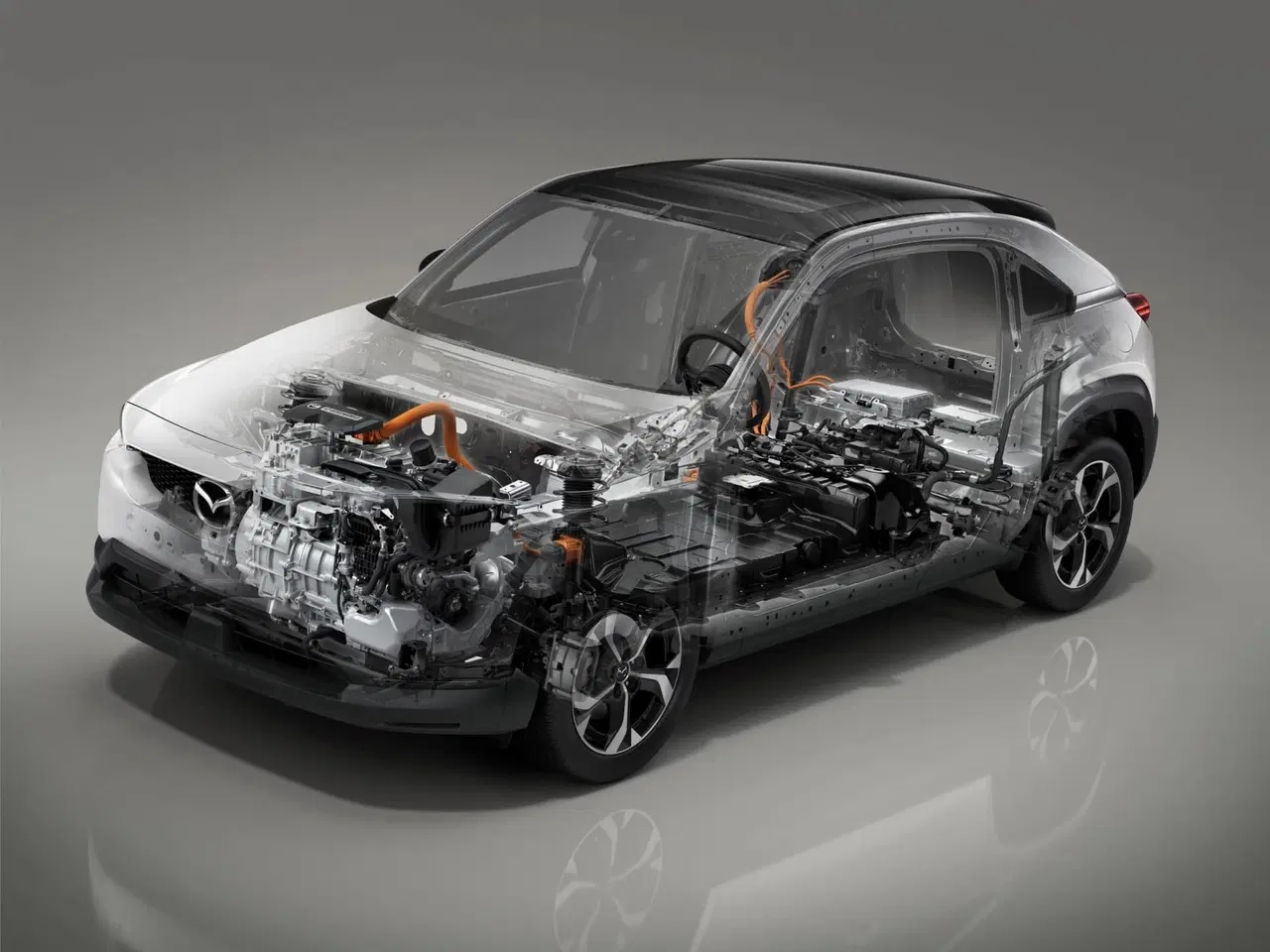
Mazda has revived the rotary engine in the MX-30 e-Skyactiv R-EV, marking a significant milestone in its innovation and electric vehicle development strategy. In this plug-in hybrid, the 8C engine does not drive the wheels directly but instead powers a generator, while an electric motor handles propulsion. Its compact design allows the internal combustion engine, generator, and electric drive unit to be housed together in the front engine bay.
Using a generator allows the engine to operate within optimal load and speed ranges; however, this alone does not guarantee the efficiency of the Wankel system. Real-world fuel consumption depends on electric range, recharging frequency, and how the combustion engine is utilized. In 2024, Mazda reactivated a rotary engine development team and continues to study the technology for electrified systems, though this does not confirm the production of a new sports car.
Frequently asked questions about the Wankel engine.
- Does a Wankel engine not have a crankshaft?.
Unlike a conventional crankshaft connected to pistons via connecting rods, this engine features an eccentric shaft that receives the thrust from the rotor and delivers usable rotational force to the transmission or generator. This shaft performs a function analogous to that of a crankshaft, even though its geometry and operating method differ. Therefore, claiming that the Wankel completely lacks an equivalent component is incorrect. The mechanism that converts combustion into rotation has been modified, but an output shaft remains necessary.
- Why does it usually have two spark plugs per rotor?.
The Wankel combustion chamber has an elongated shape and a high surface-area-to-volume ratio. This means the flame front must travel a greater distance compared to many compact piston engine chambers. Two spark plugs allow combustion to start at strategic points, accelerate propagation, and reduce areas where the mixture might burn late or incompletely. The number, position, and ignition strategy vary by generation, so not all rotary engines use the exact same solution.
- Are apex seals always the weak point?.
Apex seals are critical components, as their function is to separate the chambers at the rotor's vertices. However, they do not account for every failure in a Wankel engine on their own. Furthermore, it is crucial to consider factors such as side and corner seals, lubrication, cooling, ignition, oil quality, overheating, and previous usage. One cannot determine a single cause based solely on the presence of smoke, oil consumption, or hard starting. Diagnosis must include a compression test specific to rotary engines and a thorough review of the engine's history, operating temperature, and ignition system.
- Will the Wankel return as the primary engine for a sports car?.
Mazda continues development work involving rotary engines and electrification. However, the mere existence of prototypes, patents, or technical teams does not guarantee the mass production of a new sports car. Its most recent commercial application is as a generator in the MX-30 e-Skyactiv R-EV, where the rotary engine does not directly drive the wheels. To confirm its return as a primary engine, one would need to wait for an official announcement regarding production, specifications, and a launch date, rather than relying on rumors or concept vehicles.
The key check for a used Wankel.
Any evaluation of an RX-7 or RX-8 should include setting aside part of the budget for a specific engine compression test. This measurement must be performed at a specific temperature, with results adjusted for engine speed. The test—which also takes into account the vehicle's oil, cooling, and ignition history—goes beyond a simple visual inspection; it allows one to distinguish a healthy Wankel engine from a unit requiring an expensive rebuild.