A test reveals how far an electric car can travel after the display indicates the battery is empty.
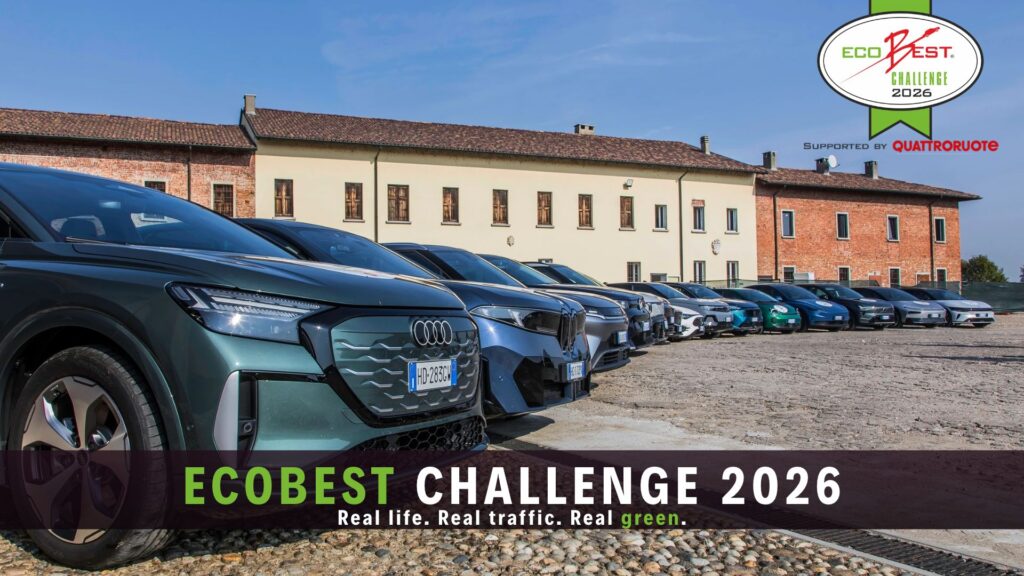
The indicator shows 0%, and the nearest charging station is a considerable distance away. The question of whether the vehicle can still reach its destination has now been answered: the Ecobest Challenge—an annual event that evaluates electric vehicles under real-world driving conditions—tested 15 such models, subjecting them to rigorous technical and performance assessments.
Once the battery was confirmed to be empty, the test continued, with the vehicles covering an average additional distance of approximately 16 kilometers. There was a notable disparity between the models: the Leapmotor B10 managed an extra 32 kilometers, while the XPeng P7+ came to a stop after just one. In the case of the Leapmotor B10, you might reach the next town; with the XPeng P7+, you would likely need to call a tow truck almost immediately.
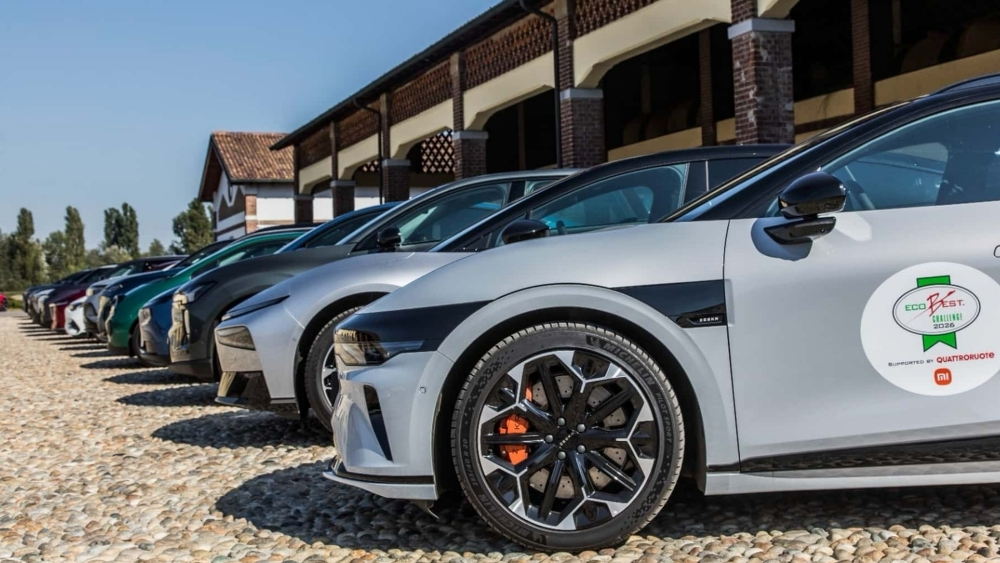
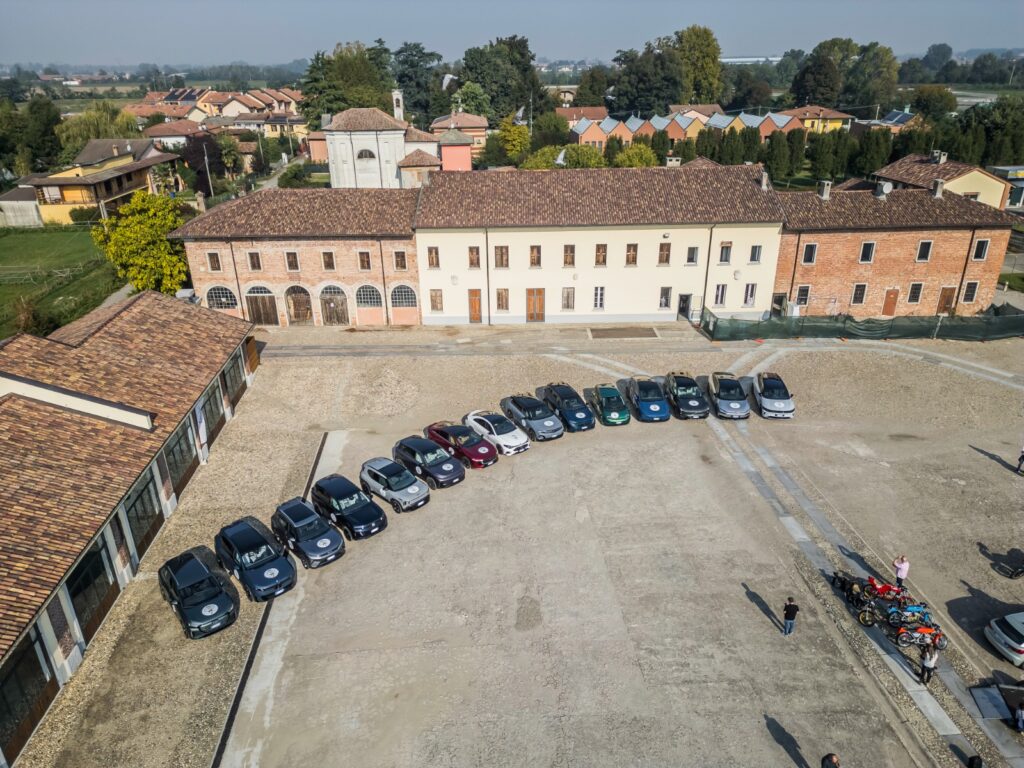
How the test was conducted.
The vehicles followed a set route near Milan that included a mix of urban areas, secondary roads, and highways. The convoy traveled in formation behind a pace car, and drivers swapped vehicles every 30 kilometers to ensure that individual driving styles did not skew the results. All the production models tested are available for purchase in Europe for under 65,000 euros (before taxes).
Each vehicle was driven by a single person, with the driving mode set to standard (not "Eco"), the climate control system turned on, and the tires inflated to the manufacturer’s recommended pressure. The final leg of the test took place at the Vairano proving ground. Once the dashboard displayed a range of 0 kilometers or a 0% battery charge, each driver continued driving until the vehicle could no longer move. A Zeekr 7GT was used for the rescue; thanks to its bidirectional charging (V2L) function, it supplied power from its own battery, eliminating the need for a tow truck.
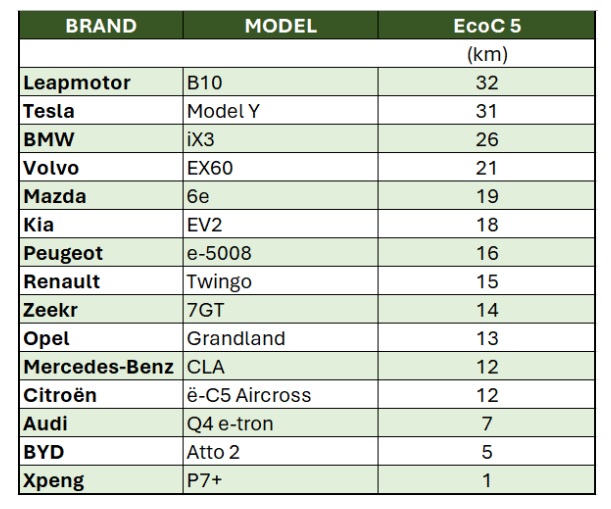
The ranking, from the largest to the smallest margin.
Following the Leapmotor B10 (32 kilometers) were the Tesla Model Y (31), the BMW iX3 (26), and the Volvo EX60 (21). In the mid-size vehicle category, the rankings included the Mazda 6e (19), the KIA EV2 (18), the Peugeot e-5008 (16), the Renault Twingo (15), the Zeekr 7GT (14), and the Opel Grandland (13). At the bottom of the list are the Mercedes CLA and the Citroën ë-C5 Aircross (12), the Audi Q4 e-tron (7), the BYD Atto 2 (5), and the XPeng P7+ (1). The average of 16.11 kilometers represents a significant improvement over the 11.1 kilometers recorded in the 2025 edition, though it remains below the 45-kilometer record set by a Subaru Solterra in 2023.
Why a car stops before the battery is fully depleted.
When an electric vehicle indicates that it is "empty," it means that the remaining range is not the full capacity. As the charge level drops, the voltage of the battery cells decreases. However, the system is designed to cut off power from the motor before it reaches a level that could compromise its integrity. Therefore, even when at rest and with the display turned off, the battery retains a small amount of energy.
It is important to note that charge level and range are not always directly related, as the estimate of usable energy may differ from the actual distance that can be traveled. In one test, a Tesla Model 3 indicated a range of 3 kilometers when its battery reached 0% charge, yet it subsequently traveled another 50 kilometers.
What this data doesn’t tell you.
The results record the distance traveled until the starting point was reached, without accounting for the remaining energy or the speed of each vehicle during that segment. Therefore, even though the Leapmotor’s reserve capacity was 32 times greater than that of the XPeng, this does not mean its performance was 32 times better. It should be noted that the vehicle in question does not show a direct correlation with its real-world range. The XPeng P7+ achieved a range of 419 kilometers—a figure that contrasts with its official rated range of 530 kilometers—representing the worst ratio in the group. Meanwhile, the Leapmotor B10 achieved a range of 357 kilometers.
For electric vehicle drivers, this is a vital lesson, as the range margin is a crucial factor for both safety and efficient vehicle management. In some models, this margin may be insufficient to meet daily driving needs. The event organizers recommend treating it as an emergency reserve.