

Download the audio
Slide 1. Introduction.
The class develops when to replace or repair a tire to save money, ensure safety, and prevent accidents.
Slide 2. When to replace or repair a tire.
- When it is safe to repair a tire.
Knowing when to repair a tire and when to replace it is essential to ensuring your safety and avoiding unnecessary expenses. Generally speaking, a tire can be repaired if the damage is minor, located on the tread, and has not affected the internal structure. However, it must be replaced if the damage is on the sidewall, if there is excessive wear, or if its structural integrity has been compromised.
For a repair to be safe, clear technical criteria established by the industry must be met. Not all damage can be repaired, so it is essential to correctly assess the type and location of the problem.
Before deciding, check that all of the following conditions are met.
- Damage to the tread.
The puncture must be located in the central area that comes into direct contact with the road surface. This part of the tire is stiffer and more stable than the sidewalls, so it can withstand a repair without compromising safety. However, repair is only recommended when the damage is limited.
- The hole must be small.
The diameter should not exceed 6 millimeters. A small puncture allows for proper sealing from the inside and maintains the tire’s structural integrity after repair.
- No structural damage.
There should be no bulges, deep cracks, or separation of the inner layers. If the casing is damaged, the tire loses its ability to safely withstand pressure and load.
- The tire must not have been driven on while deflated.
Driving with low pressure can deform and weaken the internal reinforcements, even if the external damage appears minor. This reduces reliability, even after the puncture has been repaired.
- Sufficient tread depth.
The tire must have a tread depth greater than 1.6 millimeters and show no signs of uneven wear. If it is close to the legal limit or is severely worn, repairing it is not recommended because its performance is already compromised.
In these cases, a professional internal repair using a patch and structural sealing can provide a safe and long-lasting solution. Quick external fixes should only be considered a temporary solution.
- When to replace a tire.
In some cases, replacement is not a matter of choice but a mandatory safety measure. Below, we outline the most common scenarios.
- Damage to the sidewall.
The sidewall is a very flexible area. Damage to this area affects the tire’s structure and cannot be safely repaired.
- Large cuts or blowouts.
These compromise the tire’s inner layers and reduce its structural strength.
- Holes larger than 6 millimeters.
A large puncture cannot be safely and permanently repaired.
- Tread depth below the legal limit.
When the tread depth is less than 1.6 millimeters, the tire loses traction and the risk of skidding increases.
- Multiple repairs in close proximity to one another.
Repairs in the same area weaken the casing and reduce stability.
- Tires older than five or six years.
Rubber loses elasticity over time, increasing the risk of cracks and failures.
Each of these cases poses a structural risk. The sidewall, for example, flexes constantly while driving. A repair in this area cannot guarantee long-term durability. Similarly, a tire with uneven or excessive wear loses its ability to disperse water, increasing the risk of aquaplaning.
Over time, tires also wear out, even if the tread depth still seems adequate. Most manufacturers recommend regular inspections after five years.
Replacing them in a timely manner prevents sudden failures, potential accidents, and improves the vehicle’s stability.
- How the type of repair affects safety.
Not all repairs offer the same level of reliability. There are temporary fixes that only allow you to continue driving for a limited time, and structural repairs that more safely restore the tire’s integrity.
The main differences are as follows.
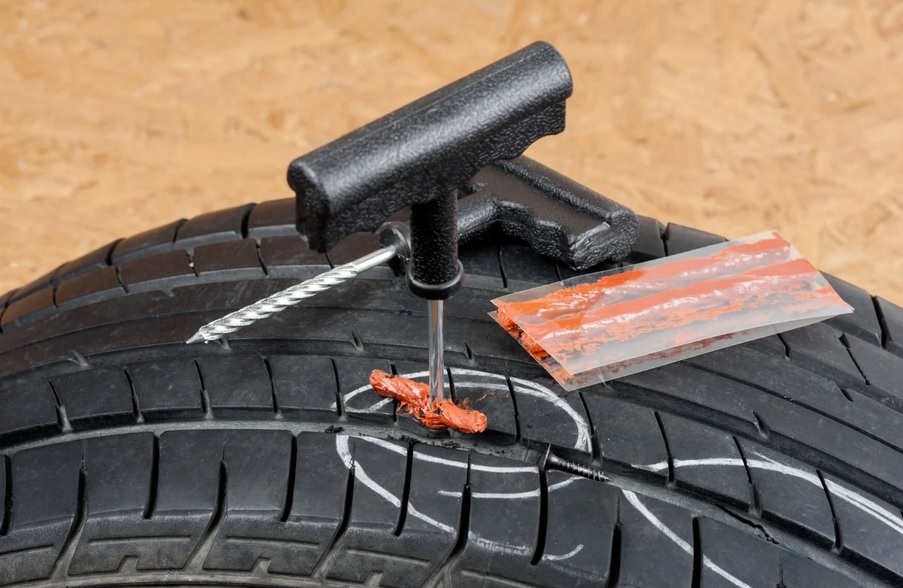
- Patch strips.
These are strips of vulcanized rubber and are the most commonly used method for repairing a flat tire due to their good value for money: they cost around 10 euros. It is not prohibited to repair punctures with rubber strips, but their use is recommended as a temporary solution, and you should have a repair shop verify that the reaming work has been done correctly. Otherwise, the strip may start letting air through again, and the tire pressure will not be correct.
- Puncture Repair Patches.
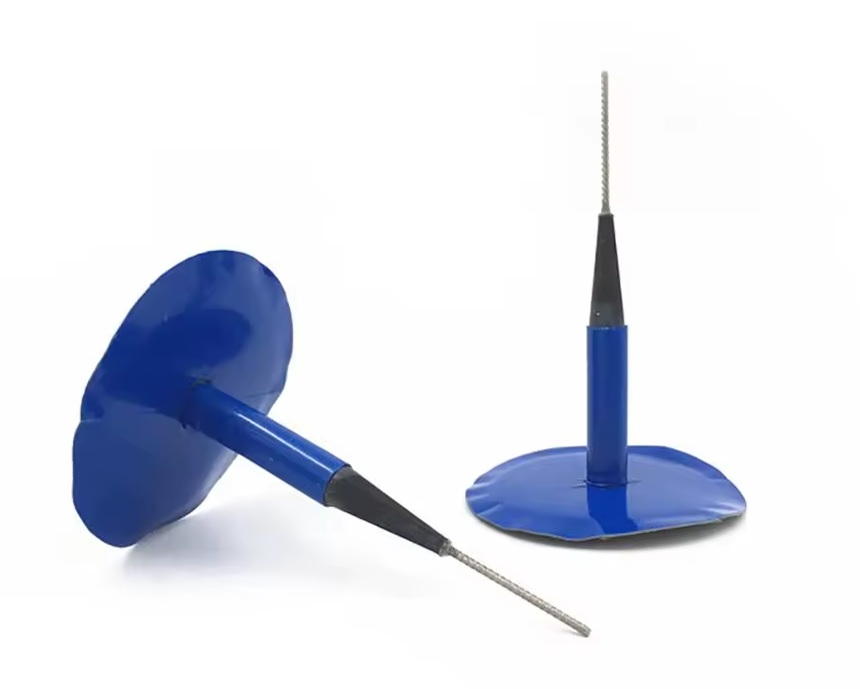
This is the most professional method. You’ll need to take your car to a repair shop to have the tire fixed. The tread is worked on from the inside of the tire, so it must be removed from the rim. A mushroom-shaped patch is placed over the hole where the air is escaping. In this case, the repair costs around 30 euros.
- Combined repair: patch + sealant.
The puncture hole is sealed using an internal patch. This method restores airtightness and improves structural strength compared to quick-fix solutions.
- Foam repair kit.
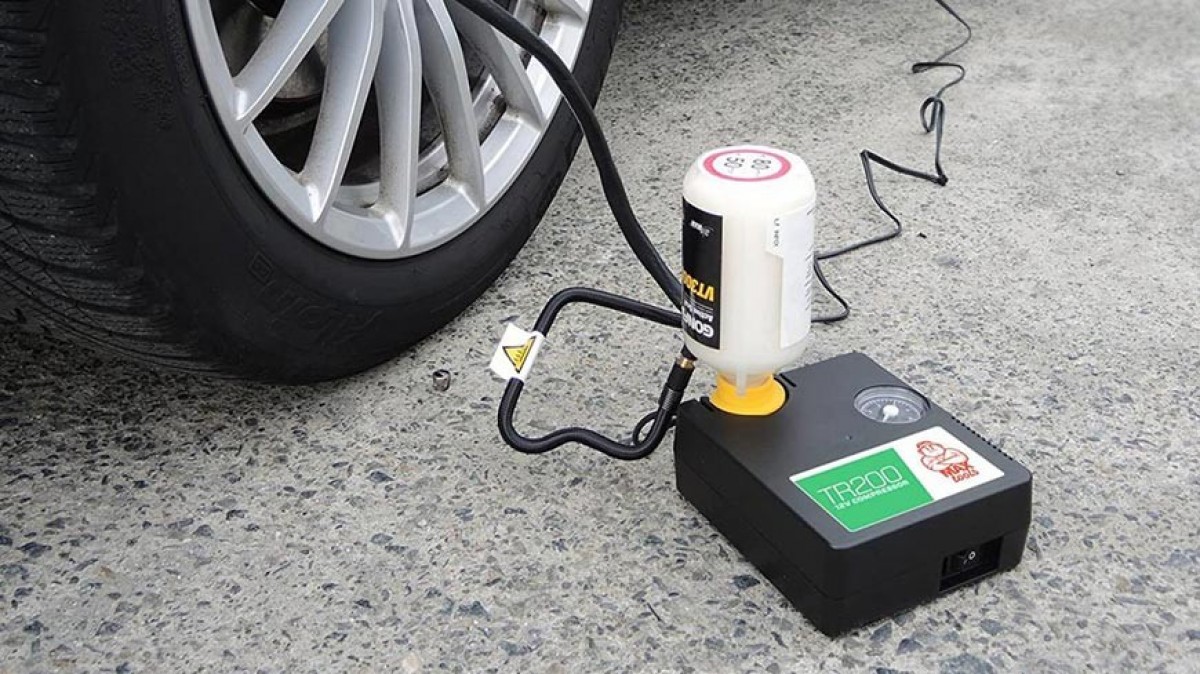
These are only effective if the object that damaged the tread is less than 3 millimeters in size. These kits inject a liquid adhesive into the tire that adheres to the hole through which air is escaping. The downside of this system, which, remember, is temporary, is that it can cause wheel imbalance because the product inside gradually deteriorates the rubber over time.
- Replacing valves.
If we can’t find where our tire is losing air, the problem may lie with the valves, which deteriorate over time and fail to maintain proper pressure.
- Additional factors to consider.
Beyond the extent of the damage, there are other factors that influence the final decision.
- The type of vehicle and its power.
Heavier or more powerful vehicles exert greater pressure on tires, so it may be safer to replace them rather than repair them.
- Intended use: city driving, highway driving, or long trips.
Long-distance travel or high-speed driving requires greater reliability than occasional urban use.
- Tire speed rating.
This indicates the maximum safe speed. Damage can affect the tire’s performance.
- Overall condition of the entire axle.
Differences between tires on the same axle can compromise the vehicle’s stability and balance.
- History of previous repairs.
Multiple repairs reduce the safety margin and weaken the tire’s internal structure.
For high-performance vehicles or long trips, it is advisable to err on the side of caution. When in doubt, it is best to replace them for peace of mind.
Additionally, replacing just one tire can affect the balance of the axle. In some cases, it is recommended to replace both tires on the same axle to maintain stability and consistent traction.
- Types of tires that cannot be repaired if they get a flat.
In addition, there are other special tires that can travel a limited number of miles even if they have a flat. These are run-flat tires. They have rubber reinforcements on the sides that come into play when the tire loses pressure. It is these reinforcements that support the car’s weight. Of course, this is only an emergency solution, as these reinforcements wear down quickly as the wheel turns. They can last up to 400 kilometers without a load or 200 kilometers with the car loaded. Under no circumstances should you exceed 80 km/h.
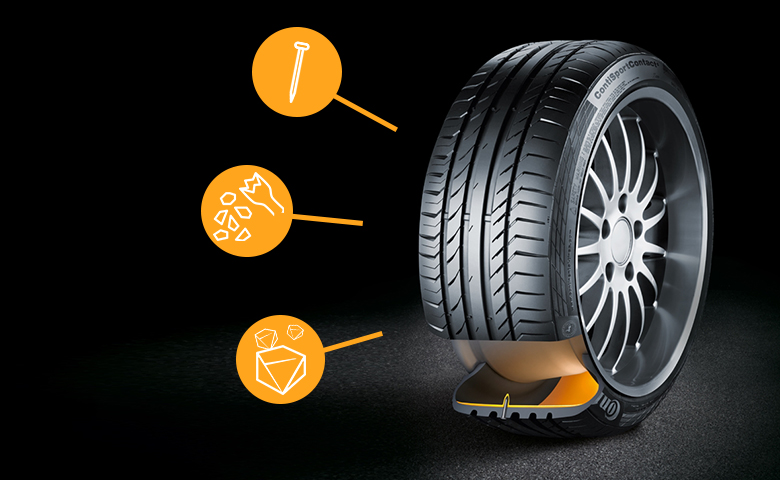
There are also Contiseal tires, which have an orange layer inside that protects the inner part of the tire. They are effective if the puncture isn’t very deep.
In both of these cases, the tire cannot be repaired, so they must be replaced once punctured.
- Implications for fleet management.
The main benefit of repairing a tire instead of replacing it is cost savings.
We recommend implementing the following measures.
- Repair the tire.
Tires account for 15%–20% of variable costs and 3%–5% of a fleet’s total costs.
Repairing is recommended over replacing the tire to save costs.
It is necessary to determine in which cases a tire should be repaired and in which cases it should be replaced without compromising vehicle safety.
- Vehicle safety.
Tires are a safety component of the vehicle; safety must always be prioritized. If repairing the tire does not ensure safety, replacing the tire is recommended.
- Rule of thumb.
To simplify the decision, simply consider three key factors: the location, the size, and the condition of the tire’s internal structure. If the puncture is small, located in the center of the tread, and has not compromised the tire’s structure, it can generally be safely repaired.
However, if the puncture is on the sidewall, is large, or there are doubts about the internal integrity, it is wisest to opt for replacement.
Although this information is useful for an initial assessment, it does not replace a professional inspection at a specialized repair shop.
- Training for our mechanics.
If the repair is performed at our shop, the mechanics must have the appropriate training and tools to carry it out.
A poorly executed repair can fail when temperatures rise, under heavy loads, or when driving at high speeds, compromising road safety.
- Specialized tire shop.
If you're unsure whether to replace or repair a tire, having it inspected at a specialized shop is always the best option.
In summary, the decision to repair or replace a tire directly affects safety, vehicle performance, and long-term savings, so it is essential to assess the tire’s location, size, and overall condition. If you have any technical questions, the most responsible course of action is to visit a specialized tire shop.
Slide 3. Thank you for your time.
The class has developed when to replace or repair a tire to save money, ensure safety, and prevent accidents, see you soon.