
Plug-in hybrids emit six times more CO2 than official figures suggest
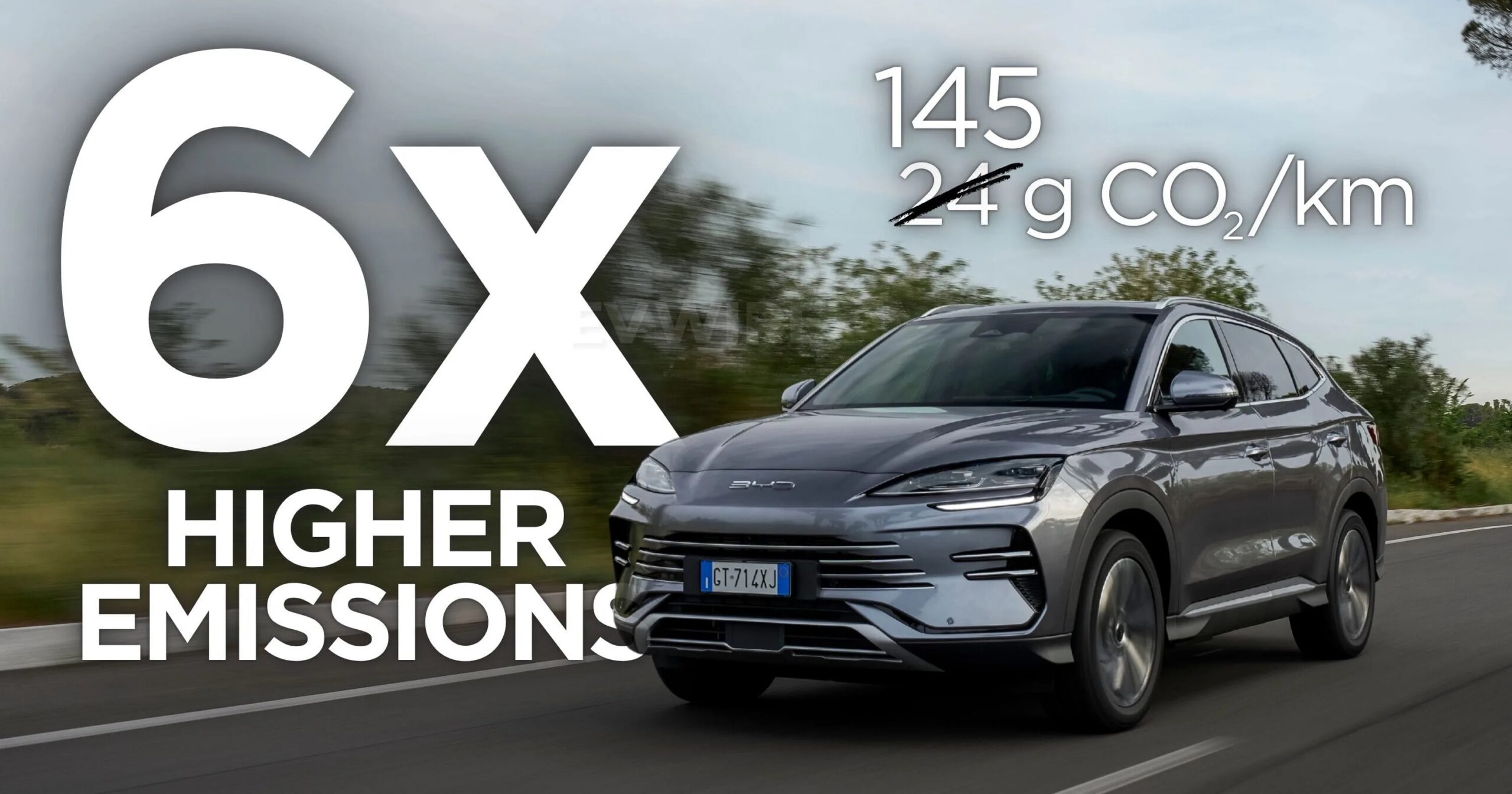
The organization Transport & Environment (T&E) bases its analysis on data provided by the European Environment Agency. According to the data collected, the actual carbon dioxide emissions of plug-in hybrid electric vehicles (PHEVs) registered in 2024 were, on average, six times higher than the official figures. In 2023, T&E reported that this factor was around five.
This discrepancy has economic implications for drivers. T&E’s calculations indicate that the additional fuel costs for a PHEV sold in 2024—when compared against official fuel consumption figures—amount to an average of €680 per year. Even when compared to conventional internal combustion engine vehicles or non-plug-in hybrids, the real-world advantage is smaller than what official figures suggest.
According to T&E’s analysis, the actual emissions of plug-in hybrids were only 14% lower than those of such vehicles, whereas official test values indicated an 83% reduction.
T&E notes that one reason for this is that the internal combustion engine frequently operates even when the vehicle is supposedly in electric-only mode. The analysis revealed that this occurs during approximately one-third of the distance traveled in battery mode.
The discrepancy between test-bench results and real-world conditions is not a new issue, as demonstrated by the International Council on Clean Transportation (ICCT). Following an exhaustive assessment of approximately eight million vehicles, researchers found that in 2023, the actual emissions of PHEVs were, on average, about five times higher than the official values established during emissions testing. The ICCT cited several causes, including lower-than-expected electric driving performance, frequent use of the internal combustion engine, and the additional weight of the dual-propulsion system.
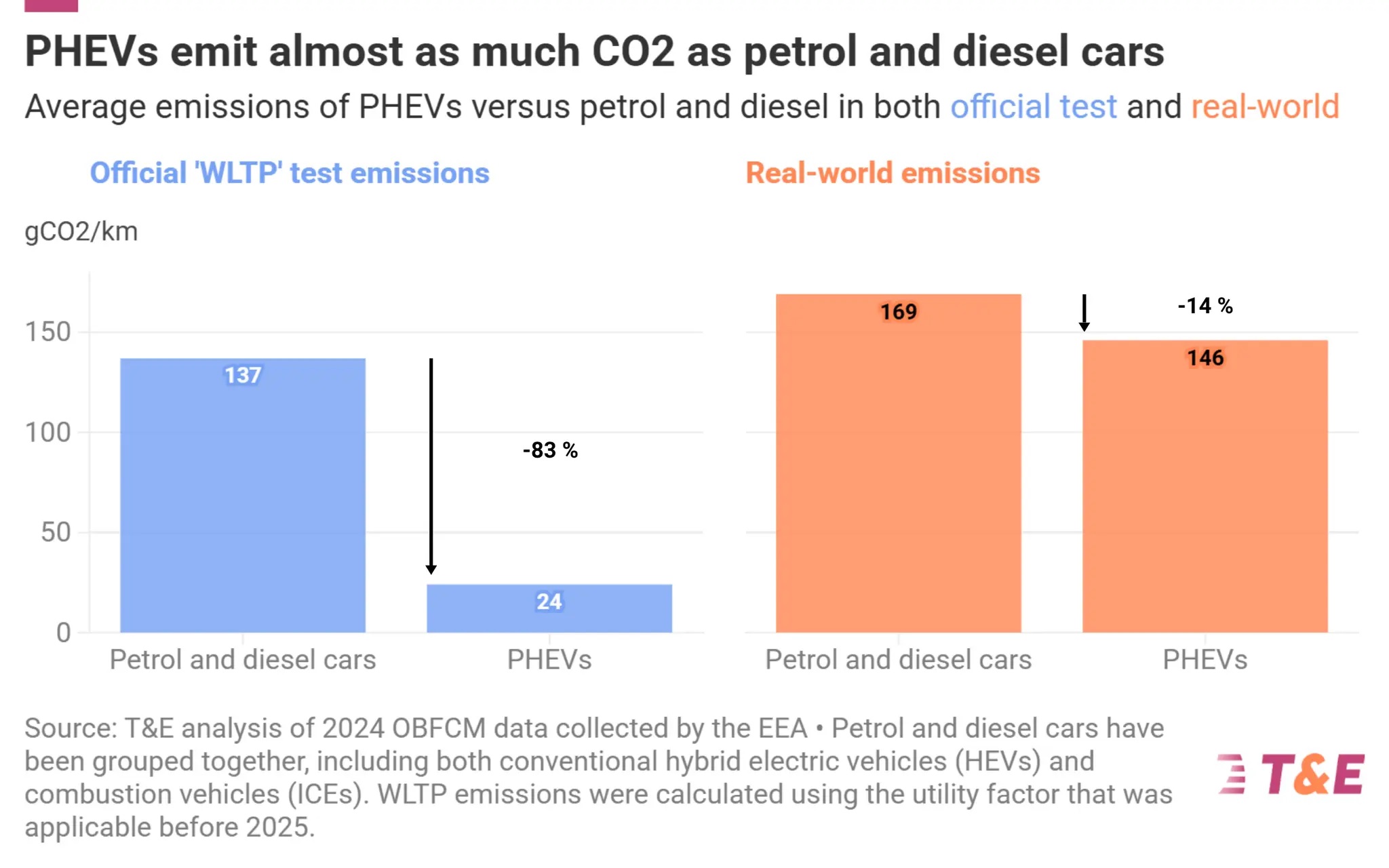
The organization Transport & Environment (T&E) bases its analysis on data from the European Environment Agency. According to this data, the real-world CO2 emissions of plug-in hybrid electric vehicles (PHEVs) registered in 2024 were, on average, about six times higher than the official figures. In 2023, T&E reported that this factor was around five.
For drivers, this discrepancy also has economic consequences. T&E estimates that the additional fuel costs—compared to official consumption figures—for a PHEV sold in 2024 amount to an average of €680 per year. Even when compared to conventional internal combustion engine vehicles and non-plug-in hybrids, the advantage in real-world conditions is smaller than what the official figures suggest. According to T&E’s analysis, the actual emissions of plug-in hybrids were only 14% lower than those of such vehicles, whereas official test values suggested an 83% reduction.
According to T&E, one reason for this is that the internal combustion engine also runs regularly during what is supposedly electric-only operation. The analysis revealed that this occurred during approximately one-third of the kilometers traveled in battery mode.
The gap between test-bench results and real-world conditions is not a new issue, as the International Council on Clean Transportation (ICCT) highlighted this summer. In an assessment of approximately eight million vehicles, researchers found that, in 2023, the real-world emissions of PHEVs were, on average, about five times higher than the official test values. The ICCT cited factors such as lower-than-expected electric driving performance, frequent use of the internal combustion engine, and the additional weight of the dual-propulsion system.
Questioning the ‘utility factor’ in CO2 emission reductions.
At the core of current regulations lies the so-called "utility factor." This factor determines what proportion of a plug-in hybrid’s total distance traveled is considered to be driven in electric mode when calculating official CO2 emissions. The EU has already adjusted this factor to bring type-approval values closer to real-world usage.
The automotive industry is now also exploring technical ways to ensure a higher share of electric driving. In 2025, the VDA proposed designing future plug-in hybrids in such a way that they would require periodic recharging. If the vehicle is not recharged before reaching a specific—yet-to-be-defined—distance, the power of the propulsion system could be restricted. This proposal was intended to address criticisms that, until now, it has been difficult to guarantee the actual proportion of electric-mode driving for plug-in hybrid electric vehicles (PHEVs).
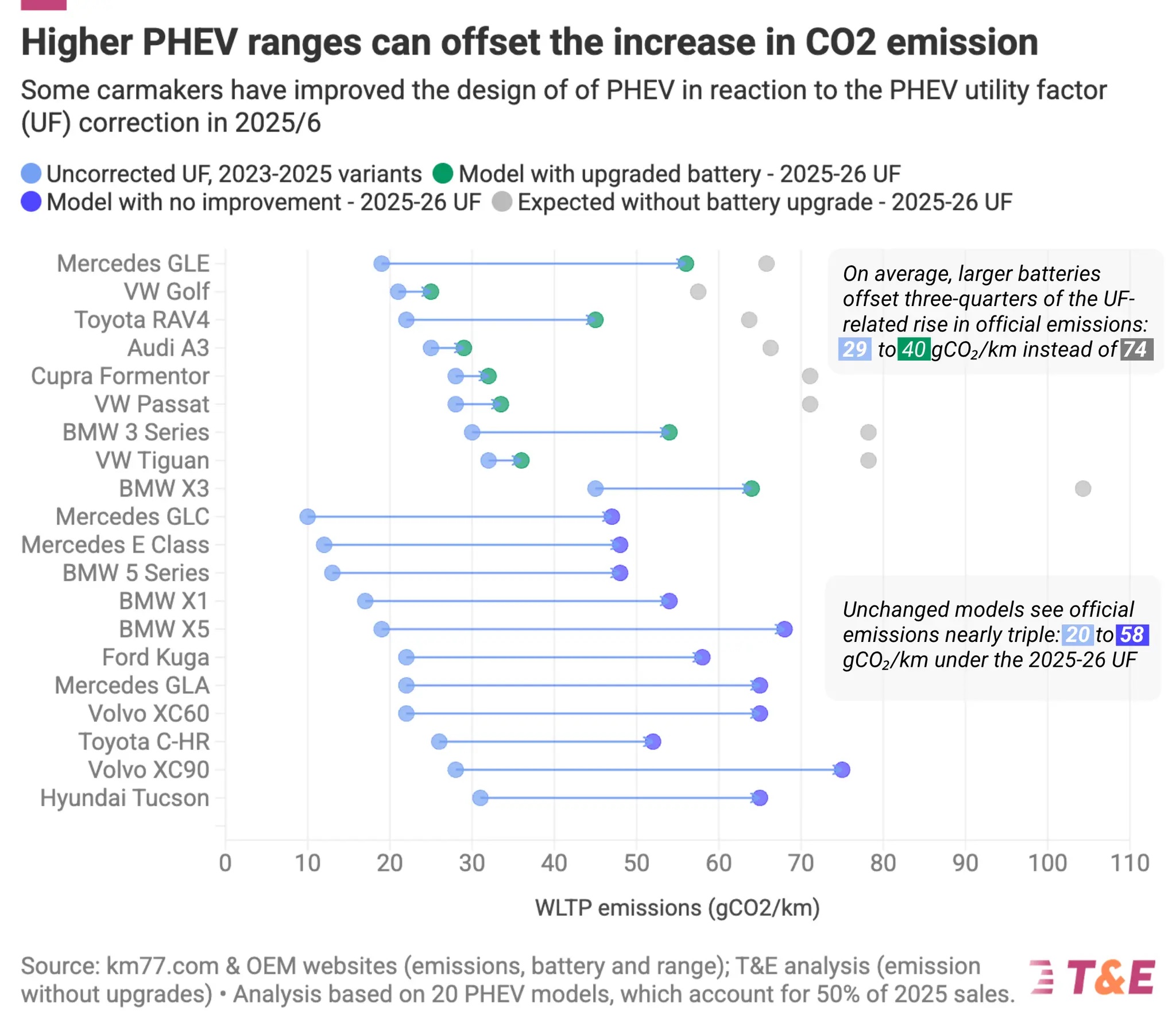
T&E has already observed a technical impact resulting from the initial adjustment. The organization analyzed 20 of the best-selling PHEV models, which together accounted for 51% of sales in 2025. According to the analysis, manufacturers responded—among other measures—by incorporating larger-capacity batteries and extending electric-only range.
The T&E study found that the adjustment was particularly significant for models within the Volkswagen Group. For the VW Tiguan, the electric range increased substantially, rising from 55 to 119 kilometers. Consequently, despite stricter calculation methods, official emissions remained at 36 g CO2/km (compared to the previous 32 g/km). Across the five VW models examined, approximately 90% of the increase in official emissions—triggered by the utility factor adjustment—was offset in this manner. According to T&E’s assessment, manufacturers could accommodate the upcoming adjustment through further technical improvements. For instance, they could increase electric range, enhance the efficiency of internal combustion engines, reduce vehicle weight, improve aerodynamics, and optimize energy recovery. The organization believes it is feasible to keep PHEVs below the 50 g CO2/km threshold.
However, the upcoming adjustment is a subject of political controversy. T&E warns against freezing the utility factor at 2025/26 levels. Based on the organization’s calculations, the real-world emissions of plug-in hybrid electric vehicles (PHEVs) would remain underestimated by 56 percent.
This situation would not only affect the fuel consumption figures reported to customers but could also have significant implications for corporate strategy. It is important to note that the lower estimated emissions for PHEVs also impact the CO2 balance of a manufacturer’s fleet. Consequently, these emissions can influence the number of fully electric vehicles that must be sold to meet European fleet-wide targets.
The ICCT has previously pointed out that the latest adjustment is insufficient to fully reflect the real-world emissions of PHEVs. It can therefore be concluded that both analyses reach a similar result, despite being based on different datasets. It is worth noting that the climate impact of plug-in hybrid electric vehicles depends not only on their technical design but is also significantly influenced by how frequently they are driven in electric mode and how often they are recharged.