
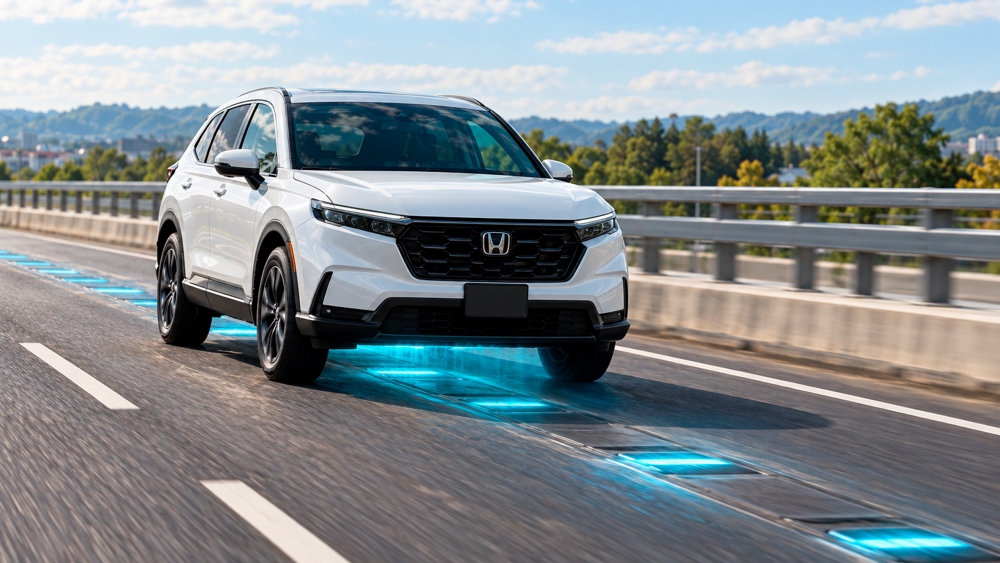
Honda’s In-Road Wireless Charging System
Honda has announced a new breakthrough in the development of wireless charging systems for electric vehicles. In collaboration with Taisei Corporation and Taisei Rotec, the Japanese company has finalized the core technology for an infrastructure capable of supplying electricity to vehicles while they are in motion. The project will move to a new phase in 2027, with the first tests on public roads expected to begin then.
The goal of this initiative is to reduce reliance on conventional charging stations—particularly in the freight transport sector, where stops to recharge can hinder operational efficiency. Although the technology is still in the experimental stage, Honda is working with power levels of up to 150 kW per transmitter unit, which would allow for the delivery of significant amounts of energy without requiring the vehicle to stop.
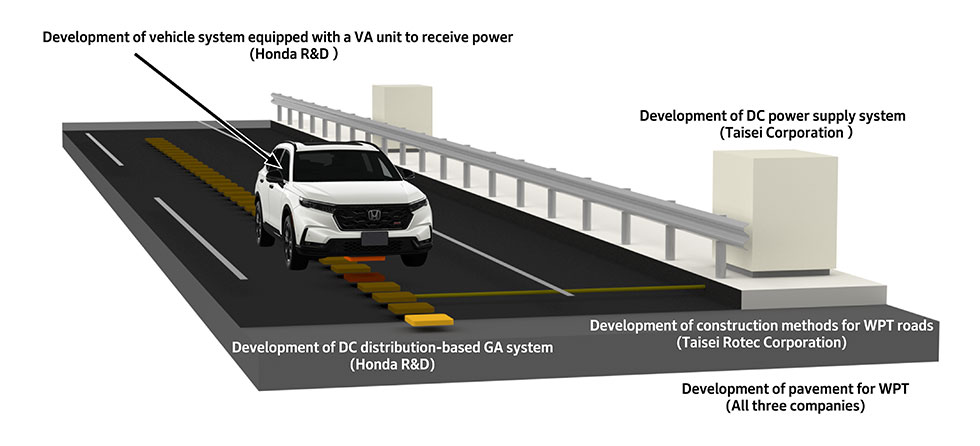
A Road That Transmits Electricity Without Physical Contact.
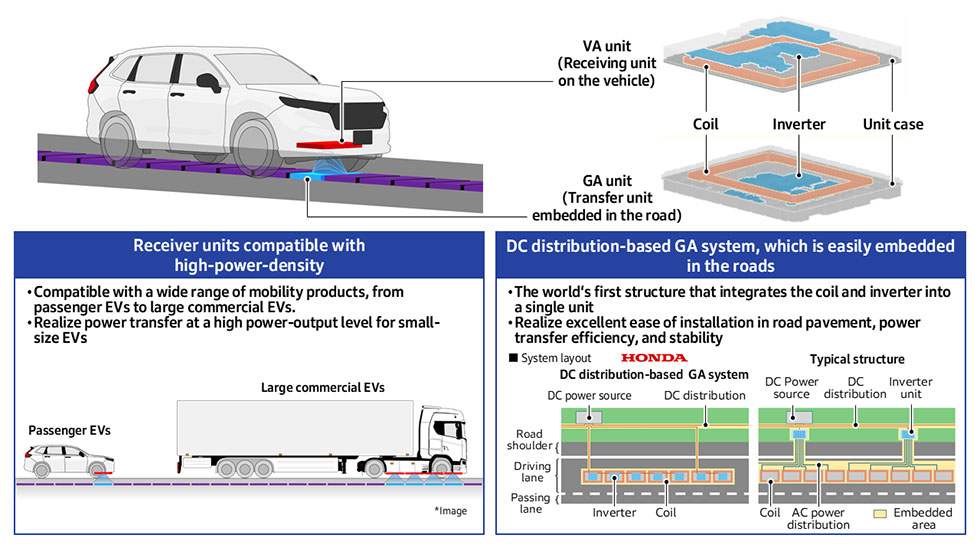
The system operates via wireless energy transfer through magnetic coupling—a process known as Dynamic Wireless Power Transfer (DWPT). To achieve this, the infrastructure incorporates transmitter devices strategically embedded beneath the asphalt; these generate a magnetic field that transfers electricity to a receiver located on the vehicle's undercarriage. In this way, energy can be transferred from the road to the vehicle while it is moving, eliminating the need for physical cables or connectors.
A key technical innovation lies in the design of the transmitters. Honda has successfully integrated the inverter and the charging coil into a single, efficient unit, with power distributed among the devices via direct current (DC). According to the company, this configuration reduces the number of components and simplifies the connections required to install the system.
Constructing these roads would not necessarily require the complete removal of the existing pavement. Taisei Rotec is currently developing procedures that would allow the transmitters to be installed by milling specific sections of the road surface. These procedures leverage routine maintenance operations, resulting in resource optimization and greater process efficiency. The system is complemented by ground-based power supply infrastructure developed by Taisei and receivers designed by Honda R&D.
Initial on-road tests are scheduled for 2027.
It is imperative that the three companies complete a series of durability and operational tests before this technology can be implemented on a highway. By late 2026, construction will begin on a new experimental track at the T-FIELD/TAMRA facility, where wear equivalent to one million wheel loads—based on a 49 kN-per-wheel standard—will be simulated to evaluate the durability of the embedded equipment.
Testing will focus on the system's performance with heavy-duty vehicles (with gross vehicle weights of approximately 20 tons) and its ability to deliver power at high speeds. Furthermore, it is crucial to verify that the electromagnetic field remains within established limits and that the infrastructure remains operational after being subjected to heavy traffic.
The next phase will take place during the Japanese fiscal year 2027, which begins on April 1, 2027. Honda will participate in a project led by East Nippon Expressway to test dynamic charging on the Tateyama Expressway in Chiba Prefecture. While the technology is primarily intended for commercial vehicles, Honda is also considering its application for passenger cars.
At present, there is no set date for commercial launch, and no public estimate has been provided regarding the cost of adapting each kilometer of roadway. The results of upcoming tests will determine the project's technical and economic viability. Japan is now joining ongoing research efforts in Europe—where experimental projects are underway in France and Germany—aimed at reducing the need for onboard energy storage and minimizing the need for charging stops during travel.