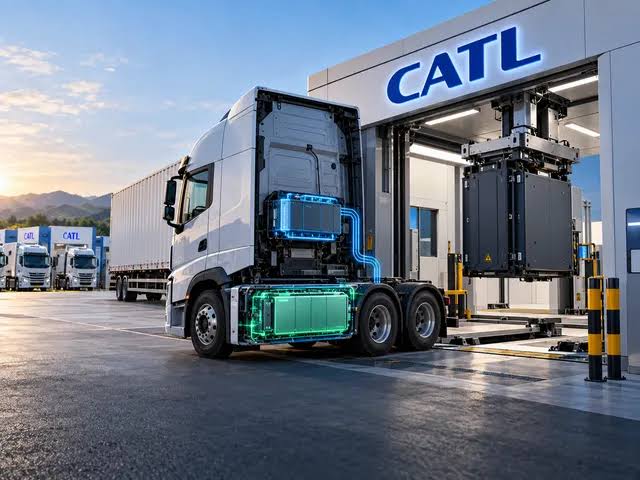
CATL Unveils New Battery Solution for Electric Trucks
China’s leading energy technology company has introduced a new system. CATL positions it as a battery option for heavy-duty electric trucks, marketing it under the name "Dual-Electric Range Extender" technology. In a statement to *Electrive*, CATL explained that the main battery—installed in the vehicle's undercarriage with capacities of 432 kWh or 513 kWh—will be available for lease through a flexible model, aimed at "reducing upfront costs."
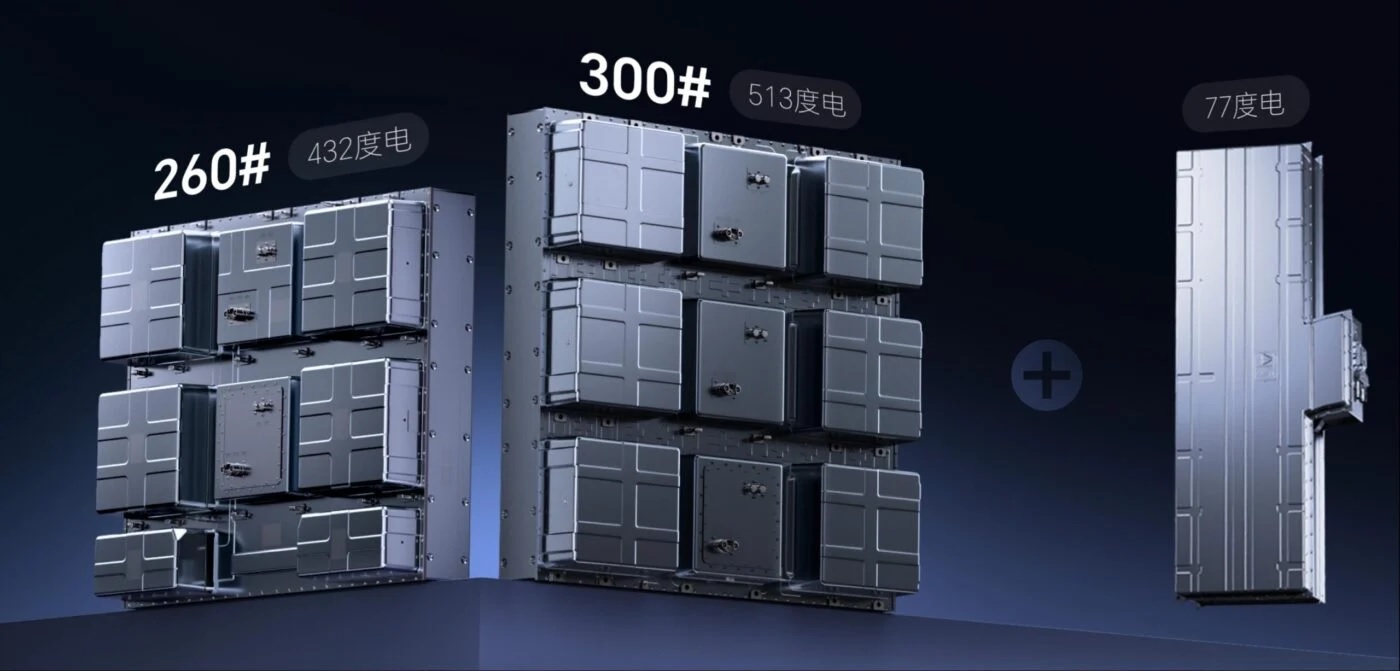
To support this new technology, CATL plans to significantly expand its "QiJi" battery-swapping station network. The company has standardized the battery units used in the system into two sizes: the 260# swap unit (432 kWh) for vehicles with a 3.8-meter wheelbase, and the 300# unit (513 kWh) for trucks with a 4.2-meter wheelbase. This design ensures the batteries are compatible with the QiJi swapping system, allowing for seamless and efficient integration. When combined with a 77 kWh auxiliary battery permanently mounted behind the cab, the system’s total capacity reaches 509 kWh or 590 kWh, respectively.
With this new approach, CATL aims to "optimize battery usage and lower operating costs for fleets." During the presentation, CATL signed public agreements with 14 partners to adopt the system, including SF Express, ZTO Express, and YTO Express—three of China’s major logistics and parcel delivery providers. The initial order volume stands at 13,000 units. The "Dual-Electric Range Extender" technology has been designed for CATL’s domestic market, where the manufacturer is significantly expanding its network of battery-swapping stations—a key component of this approach. By the end of the year, CATL aims to have 900 battery-swapping stations for heavy-duty trucks in operation, a figure set to rise to 2,000 units over the course of next year. In the long term, CATL plans to establish a total of 10,000 stations across China in collaboration with its partners.
For those wondering why CATL includes a backup battery alongside the high-capacity, swappable battery, the manufacturer provides the following explanation: according to the company, drivers of trucks equipped with conventional swappable batteries typically return to a swapping station when the charge level reaches approximately 30%. This practice results in only partial utilization of the leased battery’s capacity, which can lead to inefficient resource management. In this context, the additional backup battery serves as an effective solution. It acts as a buffer, allowing for an increase in the depth of discharge (DoD) of the main battery—from approximately 70% to over 95%. CATL maintains that this feature enables truck drivers to wait until the main battery’s charge level drops to around five percent before heading to a swapping station, thereby avoiding the risk of running out of power while on the road.
At this five percent state-of-charge (SoC) threshold, "CATL’s seamless switching technology transfers the power supply to the range-extender battery in a matter of milliseconds, ensuring a continuous and stable power supply," the manufacturer specifies. Consequently, the main battery is never fully depleted.
The system is based on CATL’s "1+X" architecture, which standardizes the main battery to ensure compatibility with the battery-swapping network, while the range-extender battery remains individually configurable.
Furthermore, CATL’s Qiji battery-swapping network for trucks will be compatible with the 75# battery module (171 kWh), as well as the 260# and 300# models (432 kWh and 513 kWh, respectively). According to CATL, the new generation of Qiji swapping stations will allow for battery swaps in a record time of five minutes. Additionally, the company states that "the station does not require an excavation pit and can be constructed in just 5 days."
As reported by CN EV News, the company is modifying the billing model for its "Battery-as-a-Service" offering by shifting to a system where customers are charged for the net energy charged, rather than the energy discharged. This allows customers to continue benefiting from regenerative braking. CATL asserts that this change has the potential to reduce battery rental costs—on a per-kWh basis—by up to 20% for users on basic rate plans.
CATL believes that battery swapping holds significant potential for road freight transport. Earlier this summer, the company acquired a nearly 25% stake in Qiyuan Green Power, the largest operator of battery-swapping stations for heavy-duty trucks in China. Thanks to this investment, CATL will be able to bring two battery-swapping technologies under one roof: its own Qiji system and the battery-swapping system from Qiyuan Green Power.
The battery-swapping solution from Qiyuan Green Power is designed for rear-mounted installation. According to an article published in August in [...], this system is notable for its high level of compatibility, working with over 80% of the heavy-duty trucks in China that support battery swapping. Please take a moment to read the latest news regarding China’s automotive sector. This approach is primarily used in closed or semi-public environments, such as mines, ports, steel mills, and urban construction sites.
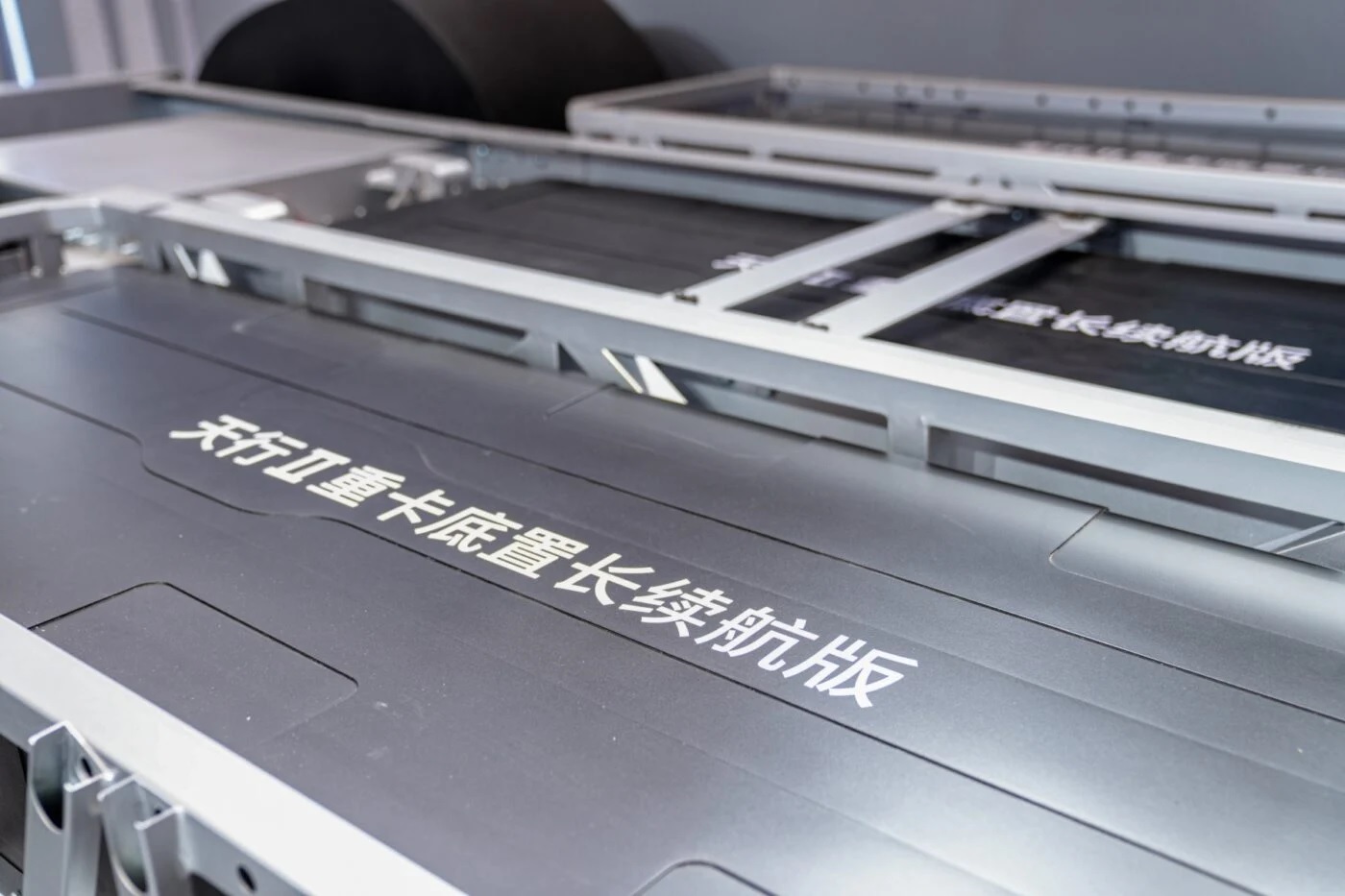
CATL’s battery-swapping system, marketed under the Qiji brand, focuses on truck chassis. The leading Chinese battery manufacturer is currently rolling out this approach within the vehicle sector, offering standardized, swappable battery units of various sizes at its stations, known as "Choco-SEB." "SEB" stands for "Swapping Electric Blocks," while the name "Choco" alludes to the appearance of a chocolate bar, with its individual segments. According to information from *China Automotive News*, the Qiji brand focuses primarily on logistics infrastructure along China’s national highways.
Regarding the scope of the network, the following has been determined: the Qiyuan Green Power network is expected to comprise more than 1,600 charging and battery-swapping stations distributed across 208 prefecture-level cities. CATL’s "Qiji" brand is estimated to have approximately 300 stations, with a target of reaching 900 stations by the end of this year.
The Chinese market for truck battery swapping is showing notable and sustained growth. One German executive with deep insight into this market is Klaus Sekot, Managing Director of Bosch MC Battery Service Innovations—a joint venture established in 2025 by Bosch and Mitsubishi Corporation, based in Ludwigsburg. The new company specializes in "Battery-as-a-Service" (BaaS) solutions and recently launched its first client project at a truck battery-swapping station located in Chizhou.
In an interview with *Electrive* this summer, Sekot explained that there are currently three parallel standards for truck battery swapping in China. Furthermore, it has been noted that China has been deliberately developing the battery-swapping market since the early 2020s, with the aim of strengthening its industrial policy. According to information provided by Sekot, approximately 30,000 heavy-duty trucks compatible with battery-swapping systems were registered in China in 2024.