
Download the audio
- Introduction.
The class develops autonomous vehicles at Haneda Airport in Japan, which transport luggage.
- Autonomous vehicles at Haneda Airport.
Although it will be some time before autonomous cars are driving on the streets, in smaller, controlled environments these vehicles have already proven to be fully operational and functional. Toyota has already begun implementing driverless autonomous vehicles with level 4 autonomy technology in operations at Haneda Airport, one of Japan's busiest airports.
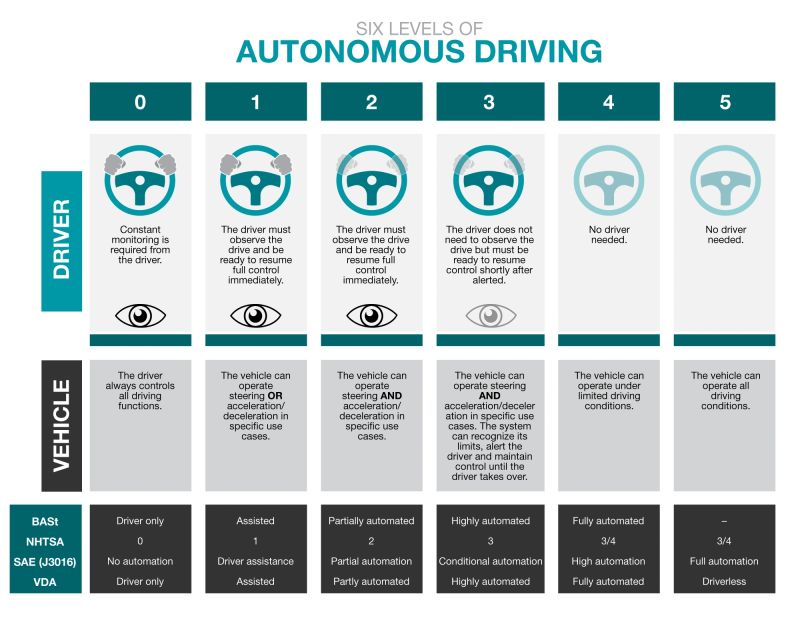
Starting this month, three electric tow tractors designed by Toyota Industries Corporation have begun performing regular baggage and cargo container transport tasks for domestic flights operated by All Nippon Airways-ANA, and three more units are expected to join the fleet by March 2026. This implementation marks the first practical application of Level 4 autonomous driving in the restricted area of a Japanese airport.
- Driverless, but with remote monitoring if necessary.
These unmanned vehicles can locate themselves in space, detect obstacles, and move without human intervention under certain conditions. Although they can operate completely autonomously, they also have remote monitoring systems that allow human intervention in complex situations, especially near active runways or areas with heavy traffic.
Their main function is to transport baggage containers from the boarding gates to the cargo hangars, traveling approximately 1.5 kilometers with two traffic lights within the airport. In autonomous mode, these vehicles can reach a maximum speed of 15 km/h and tow up to 13 tons, while under manual control they can accelerate to 25 km/h and tow up to 27 tons.
These speed limitations in autonomous mode have been established with the aim of prioritizing safety in congested airport environments, where precision is more important than speed.
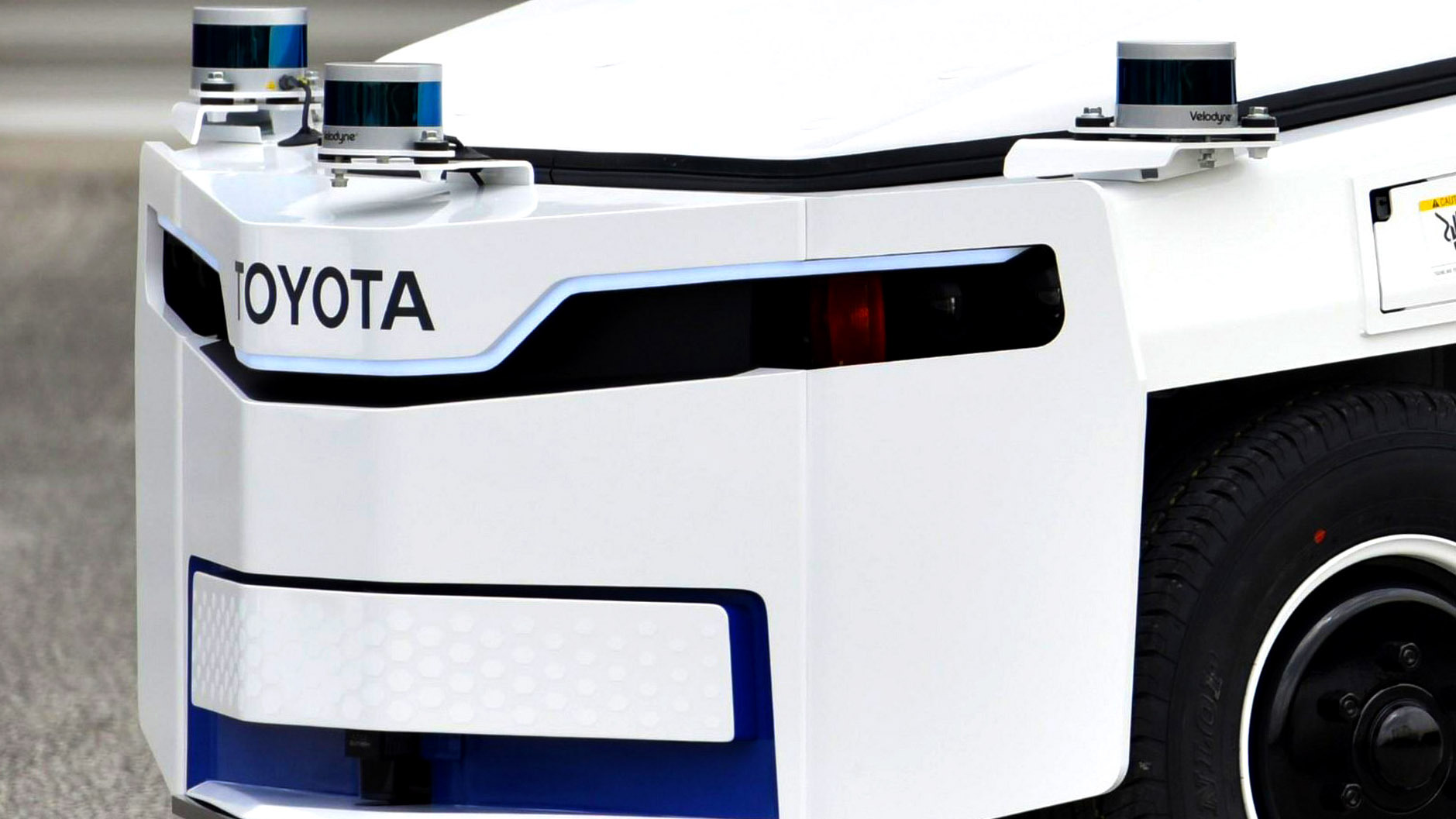
In terms of aesthetics, the design has evolved subtly from previous prototypes, maintaining a robust and functional silhouette. As expected, the Toyota emblem is located on the front, accompanied by modern headlights similar to those of a conventional car. Although the cabin is designed for two occupants, it is intended to operate without a driver, prioritizing autonomy.
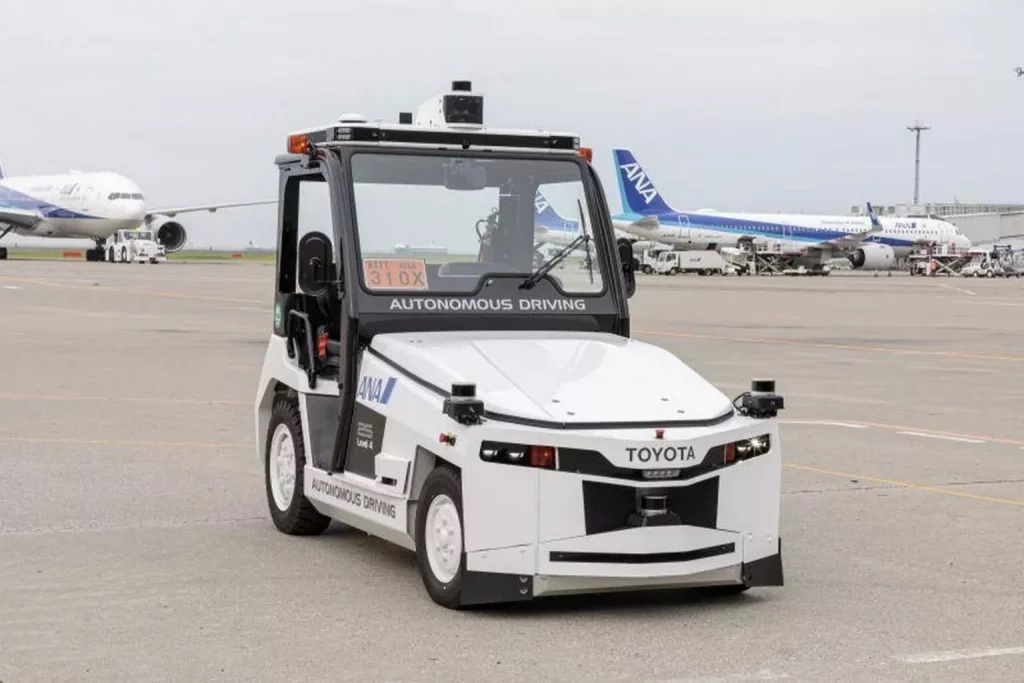
The technology implemented in these tractors combines advanced sensor, positioning, and fleet management systems. These vehicles are equipped with multiple sensors, including LiDAR (Light Detection and Ranging), cameras, and high-precision global navigation systems that allow them to scan their surroundings and respond to potential obstacles or changing conditions in real time. In addition, a fleet management system has been developed that coordinates tasks, assigns routes, and communicates with traffic lights and other airport systems to optimize movements and reduce delays in logistics operations.
- A long-term project.
This joint project between Toyota Industries and ANA did not come out of nowhere, but is the result of several years of development and testing. Trials with autonomous tractor units began in 2019 at regional airports with Level 3 technology, and intensified in 2024 with Level 4 fully autonomous driving tests. Development has focused on overcoming the technical and safety challenges of operating in restricted areas of the airport, with the aim of fully implementing this technology by the end of this year, which has finally been achieved.
The company points out that, in addition to improving operational efficiency, this type of autonomous system responds to the structural challenges facing the sector, such as labor shortages in airport logistics and the growing volume of passengers and cargo. The use of autonomous vehicles can help streamline baggage handling processes and reduce dependence on human drivers, while integrating with airport management systems to operate safely and efficiently.
ANA and Toyota's strategy is to progressively expand this fleet of autonomous tractors, evaluate their performance and scalability, and introduce up to 50 units at Haneda by 2030, as well as extending the technology to other major airports in Japan.
- Thank you for your time.
The class has developed autonomous vehicles for Haneda Airport in Japan that transport luggage, see you soon.