

An electric truck can save up to 128,000 euros compared to a diesel one
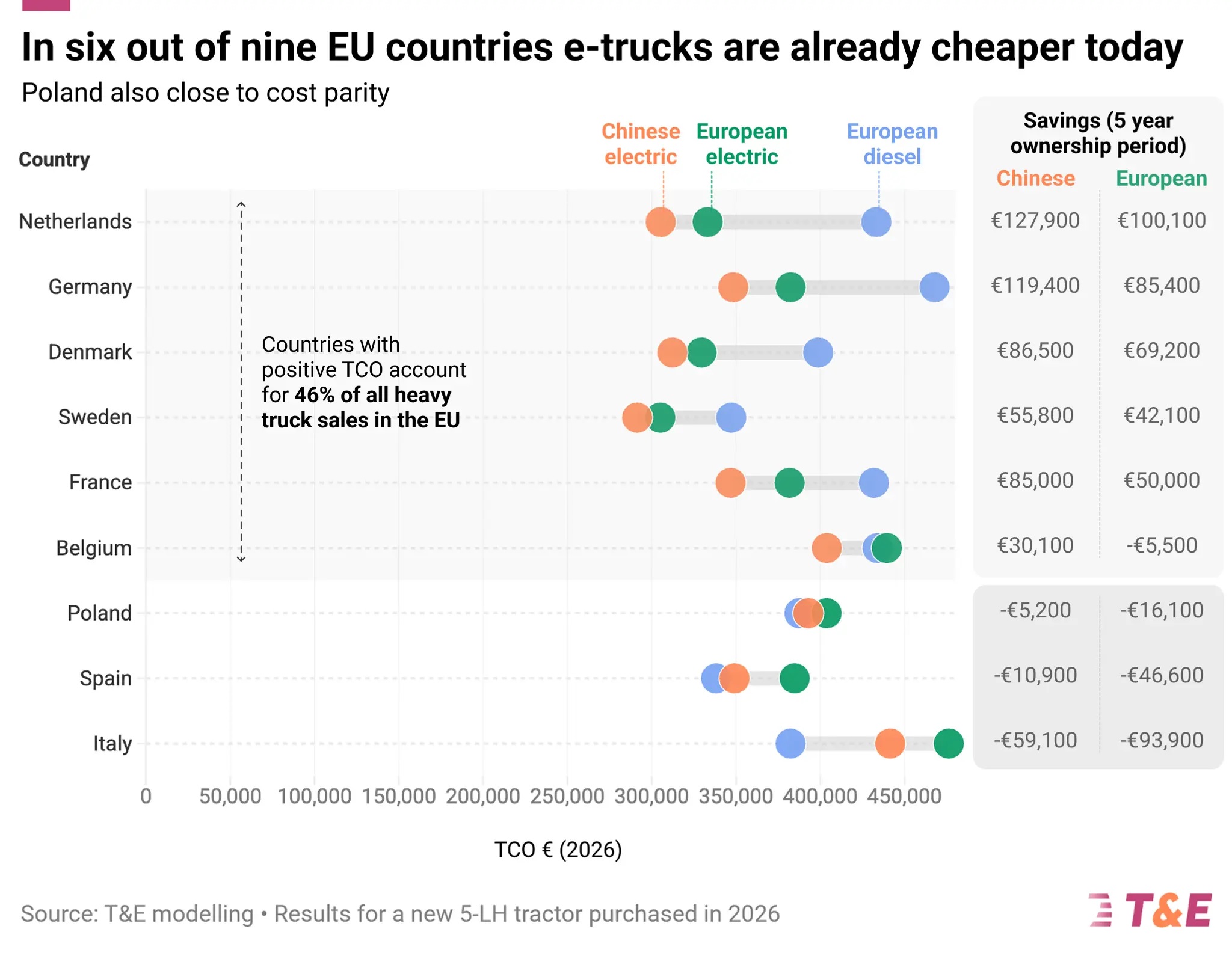
Electric trucks are overcoming one of the main obstacles currently limiting their expansion in the heavy transport sector: cost. A recent analysis conducted by Transport & Environment (T&E) concludes that, in six of the nine major European markets evaluated, vehicles powered by alternative energy sources are already more economical than diesel ones. This analysis, carried out objectively and professionally, reveals that, collectively, they account for more than 46% of new heavy-duty truck registrations in the European Union.
The study is based on the concept of Total Cost of Ownership (TCO), which encompasses more than just the vehicle's purchase price. This approach—already established in the passenger car and SUV sectors—is particularly relevant for trucks because the cost of operation over their lifespan can be significantly higher than the initial price difference between an electric model and a diesel one.
Up to 128,000 euros over five years.
In the Netherlands, a company operating an electric truck can save up to 100,000 euros over five years compared to a diesel model. In Germany, savings would reach 85,000 euros, while in Denmark, the figure would be around 69,000 euros. In these three markets, the initial price premium for an electric vehicle could be offset within approximately two years of use.
The study addresses a particularly relevant variable that highlights the continued significant influence of purchase price: the truck's origin. By using a Chinese-manufactured model—which has a significantly lower purchase cost—accumulated savings of 128,000 euros can be achieved in the Dutch market over a five-year period. This represents a reduction of nearly €30,000, thereby shortening the time required to recoup the additional initial investment.
The sector's evolution is attributed to multiple factors. On one hand, manufacturers are progressively increasing the production of electric trucks, allowing them to leverage economies of scale and lower vehicle prices. On the other hand, there are national incentives and disparities in operating costs—particularly regarding road tolls. Energy costs play a crucial role, given that heavy-duty trucks cover significantly greater distances than private passenger cars. Consequently, any price difference between electricity and diesel has a substantial impact on a transport company's bottom line. In this regard, T&E maintains that current diesel price trends are widening the operating cost gap in favor of electric models.
Results vary by country.
The economic viability of an electric truck depends on various market-specific factors, such as purchase price, energy costs, taxes, tolls, and available subsidies. Consequently, the study identifies three countries that represent the negative side of the analysis: Belgium, Poland, and Spain.
In the first case, after five years, the electric truck buyer faces a net loss of €5,500. However, opting for a Chinese model results in savings of €30,100. In the other two cases, the outcome is negative regardless of the truck's origin. In Poland, purchasing a Chinese model entails a net cost of up to €5,200 over the first five years; however, this figure rises to €16,100 for models from other origins. In the Spanish context, the situation is even more critical, with figures ranging from €10,900 to €22,200 per case.
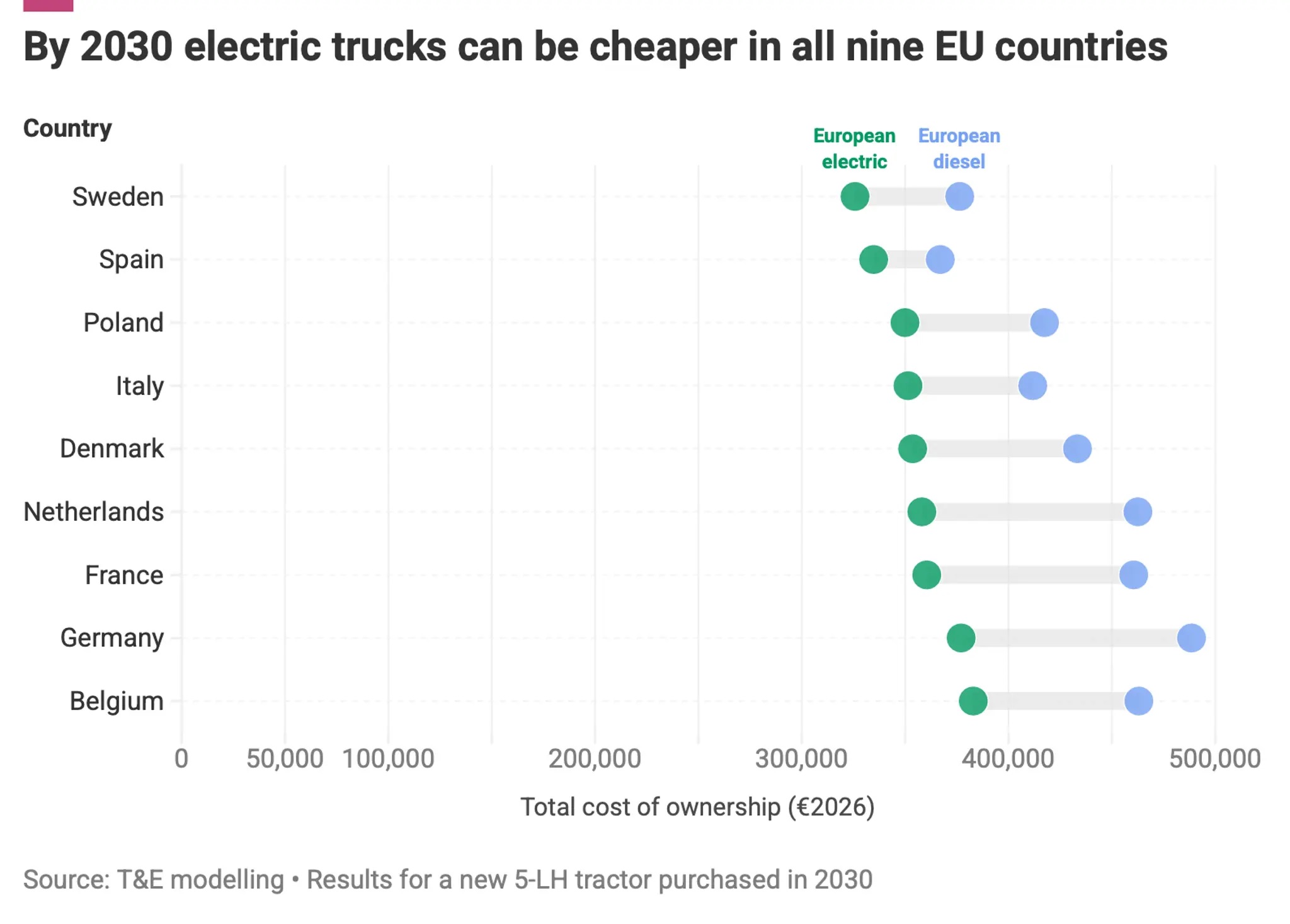
However, the outlook for the coming years is more favorable. The model developed by T&E estimates that, if current policies remain in place and certain complementary measures are implemented, electric trucks could become more cost-effective than diesel ones by 2030 across the nine countries studied.
The organization notes that this could happen even if some current direct purchase subsidies are reduced or eliminated. Nevertheless, T&E identifies several measures as fundamental to achieving this: maintaining European emission reduction targets for trucks, implementing CO2-linked toll systems, and extending mechanisms to lower the cost of electricity used to charge vehicles at transport company depots.