


A tiny sensor key to preventing thermal runaway in electric vehicle batteries
Lithium battery degradation can begin long before its effects become visible. It has been shown that internal chemical changes generate signals that leave traces in the oil used to cool the system.
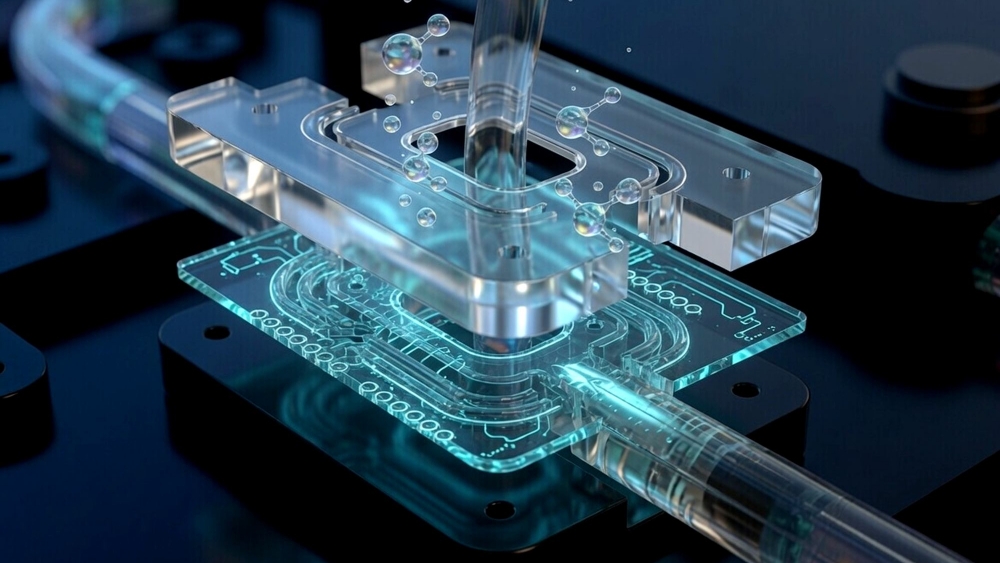
The purpose of MicroSensOil—a microfluidic device conceived by researchers at Tecnológico de Monterrey—is the early detection of signs of failure that could lead to fires or explosions.
Going beyond the BMS to overcome its limitations.
The increasing use of lithium batteries in electric vehicles and energy storage systems has created significant demand for this technology. Gradual degradation, component aging, or coolant contamination can trigger internal reactions that are difficult for conventional systems to detect. In extreme cases, these reactions can result in thermal runaway—a chain reaction linked to overheating that can lead to fires and explosions.
The project is led by David Ramírez Rios, a digital systems and robotics engineer holding a Master of Science in Engineering, who is currently in the third semester of his doctoral studies at Tec. The technical advisor is Javier Izquierdo Reyes, a communications and electronics engineer with a doctorate in science and engineering from Tec and a completed postdoctoral fellowship at the Massachusetts Institute of Technology (MIT).

The proposal is based on the limitations of conventional battery management systems, commonly known as BMS. These platforms monitor electrical parameters—such as voltage, current, and temperature—to evaluate performance and predict the battery's state of health. While they are essential tools, they often detect degradation only after the damage is already advanced.
Instead of waiting for the battery to exhibit anomalous behavior, MicroSensOil proposes examining the chemical indicators that appear during the initial stages of degradation. This strategy entails a proactive approach to monitoring battery performance, rather than a reactive response to malfunctions. To this end, the microsensor analyzes small quantities of cooling oil to detect gases or compounds associated with degradation processes.
"Before a battery suffers an obvious failure, internal chemical changes occur that leave traces in the cooling oils," explains Dr. Javier Izquierdo Reyes, a professor and researcher at the School of Engineering and Sciences at Tecnológico de Monterrey. The research, he adds, aims to read this "physicochemical fingerprint" of aging before the consequences become apparent.
The project's primary goal is to shift from reactive to predictive maintenance. If signs of degradation can be identified early enough, system operators could take measures—such as modifying operating conditions or replacing specific components—before a serious breakdown occurs.
To develop the microsensor, the researchers employed microfabrication and additive manufacturing techniques. The project focuses on integrating electrodes, channels, and analysis systems into microscopic structures to significantly reduce the required sample size. Once scientific research and experimental validation are complete, the team plans to build a prototype that will be manufactured and tested by Tec scientists in specialized laboratories at MIT.
The proposal is based on the limitations of conventional battery management systems, commonly known as BMS. These platforms monitor electrical parameters—such as voltage, current, and temperature—to evaluate performance and predict the battery's state of health. While they are essential tools, they often detect degradation only after the damage is already advanced.
Instead of waiting for the battery to exhibit anomalous behavior, MicroSensOil proposes examining the chemical indicators that appear during the initial stages of degradation. This strategy entails a proactive approach to monitoring battery performance, rather than a reactive response to malfunctions. To this end, the microsensor analyzes small quantities of cooling oil to detect gases or compounds associated with degradation processes.
"Before a battery suffers an obvious failure, internal chemical changes occur that leave traces in the cooling oils," explains Dr. Javier Izquierdo Reyes, a professor and researcher at the School of Engineering and Sciences at Tecnológico de Monterrey. The research, he adds, aims to read this "physicochemical fingerprint" of aging before the consequences become apparent.
The project's primary goal is to shift from reactive to predictive maintenance. If signs of degradation can be identified early enough, system operators could take measures—such as modifying operating conditions or replacing specific components—before a serious breakdown occurs.
To develop the microsensor, the researchers employed microfabrication and additive manufacturing techniques. The project focuses on integrating electrodes, channels, and analysis systems into microscopic structures to significantly reduce the required sample size. Once scientific research and experimental validation are complete, the team plans to build a prototype that will be manufactured and tested by Tec scientists in specialized laboratories at MIT.